Category Archives: Black History
Myrtle Black History: Music in the Greene [Part 3]
Brooklyn’s Black Broadway
Theater has been a staple of live entertainment in America at least since early days just after this country proclaimed its independence at the close of the Revolutionary war. As early as 1866, the city’s center of theatrical activity was in Manhattan’s Union Square, before it moved thirty blocks or so uptown to what we know as Broadway today. Theaters did not arrive in the Times Square area until the early 1900s, and most came and went with alarming speed. Built mostly of wood and lit primarily by flaming gaslight, the theaters of the late 1800s were infamous firetraps.
Fire in a Crowded Theater
Such was the case on the evening of December 5, 1876, when a kerosene lamp set some scenery aflame during a sold-out holiday season performance at the Brooklyn Theatre near the corner of Washington and Johnson streets (current site of the Brooklyn Post Office at Cadman Plaza, built shortly thereafter). An estimated three hundred lives were lost, making it one of the deadliest disasters in Brooklyn history and prompting new fire laws. With the literal fires of the old gaslight days quelled, few could have anticipated another kind of fire to ignite the theatrical stage, nor could they have predicted the coming Jazz age of the 1920s and 30s; Brooklyn and African American performers to be at the center of it.

Damage after the tragic fire at the Brooklyn Theater in Downtown Brooklyn in 1876.
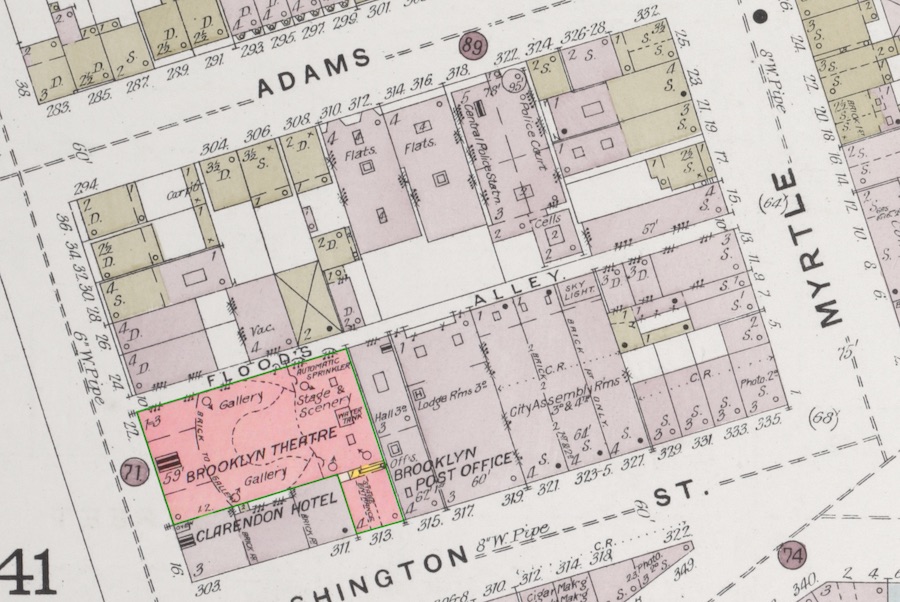
Map showing the former Brooklyn Theater off of Myrtle Avenue in Downtown Brooklyn.
A Thriving Theater District
Today the only remaining vestiges of Brooklyn’s viable theater district are the Brooklyn Academy of Music; the BAM Harvey Theater, and the former 4,000 seat Strand Theater, (repurposed and occupied by BRIC and Urban Glass).
These early century Beaux-Arts theaters and Vaudeville houses represent only a handful of handsome theaters once scattered along Fulton Street and its nearby side streets, comprising downtown Brooklyn’s Theater district.
During the Victorian era, the city of Brooklyn had become home to approximately two million residents, with at least two hundred theaters, burlesque halls, vaudeville and opera houses to accommodate them. Several first rate theaters occupied the downtown Brooklyn area—among them, the Grand Opera House; the John W. Holmes Star theater; The New Montauk Theater; and the Columbia Theater (successor to the catastrophic Brooklyn Theater). It was not until 1908, when the first subway train was opened at Borough Hall, that the decline and fall of the Brooklyn Theater set in. Many were replaced by nickelodeons and motion picture houses or torn down to make way for the expansion of the main Brooklyn Post Office and office buildings, among them, Werba’s Brooklyn Theater on the busy intersection of Flatbush and Fulton; The Brooklyn Music Hall; William Bennett’s Casino; the Gotham Theatre; and the 1,741 seat RKO Orpheum Theater (Fulton and Rockwell Place), diagonally across from the Strand and the Majestic theaters.
A Place for Brooklyn Black Actors
Hooley’s Opera House on Court and Remsen, featured “minstrel shows” (white musically adept comedians in black-face, imitating African Americans), but this brand of burnt-cork, racist entertainment was eventually replaced by actual African American musicians, composers, dancers, and singers—many of the acts having completed successful runs on Broadway or aspiring to get to Broadway. Mamie Smith, African American vaudeville singer, dancer, pianist, and actress made history in 1920 when she became the first black female recording artist (pre-dating Ma Rainy and Bessie Smith). Ms. Smith and her Jazz Hounds performed regularly at the Putnam Theater on Fulton and Grand. First opened in 1885, the Putnam first opened as the Criterion, changing its name half a dozen times before it’s balcony would suffer from a balcony fire) was renovated and reopened in 1918 as a stock burlesque house before it was demolished in 1937.

The famous African American comedy trio of WILLIAM & WALKER Co. (and Walker’s wife, Adah Overton White, a noted performer in her own right) appeared in their comedy/vaudeville musical, “Bandanna Land”, with a large a cast at the Grand Opera House in downtown Brooklyn, Brooklyn in 1908. Created by and featuring African Americans, “Bandanna Land”, was a large undertaking for Bert Williams, George Walker, and Ava Overton Walker. As a central figure on America’s vaudeville circuit, the comedy duo sang, danced and pantomimed, their act becoming a bold shift away from the traditional white black-faced entertainment that had dominated the era. The two men set up an agency, The Williams and Walker Company, to support African-American actors and other performers, create networking, and produce new works. One critic wrote for “Billboard Magazine” wrote:
“Williams and Walker have a vehicle which is making them popular… their eccentric style of character-drawing produced what is, no doubt, the highest type of negro achievement on the stage to-day. The company is made up of some clever people. In the first act there is a meeting of a corporation, which is so finished in every detail of costuming, grouping and by-play, that it is only after the fall of the curtain, that you realize how much has gone into its current presentment…If Belasco could get half the atmosphere into a production that Bandanna Land produces in such abundance, he would be rejoiced.”
Another critic in Variety magazine opined:
“‘Bandanna Land’ is a real artistic achievement, representing as it does a distinct advancement in Negro minstrelsy. Realizing, perhaps, that the white public is chronically disinclined to accept the stage negro in any but a purely comedy vein and having at the same time a natural desire to be something better than the conventional colored clown whose class mark is a razor and an ounce or two of cut glass, Williams and Walker have approached the delicate subject from a new side….’Bandanna Land’ has found substantial success at the Majestic Theatre, where it is now in its fourth week with an almost unbroken record of capacity business. No small part of the credit for this result is due to Will Marion Cook, who wrote the music, and to the splendid singing organization. The score is full of surprises, crisp little phrases that stick in the mind and are distinctly whistle-able, and several of the lyrics that go with them are excellently done.”

Actors and producers, Bert Williams & George Walker.
Moving on Up to Broadway
The New York Times proclaimed the musical comedy received a “response from the audience that was utterly deafening and had to be encored thirteen times.” Their musical moved to Broadway several months later, but sadly, it was the last show featuring the duo of Bert Williams and George Walker before Walker became ill and died in 1911, age 38. His widow, Ada Overton Walker, performing solo after the death of her husband, became known as “Queen of the Cakewalk”, and well known for her 1912 dance performance of “Salome” (in response to the Salome craze that spread through the white vaudeville circuit) on Broadway at Hammerstein’s Victoria Theater. Bert Walker continued to perform across the country including on Broadway with the Ziegfeld Follies. Walker & Williams can certainly be credited with paving the way for many African American performing artist (though all three died impoverished before the age of 50) as African American artistic expression became acceptable to white audiences.
“Shuffle Along”, which opened on Broadway in 1921, was the first major production in more than a decade to be produced, written, performed and directed entirely by African Americans, thus restoring black artistry to the mainstream of the American theater. A daring synthesis of ragtime and operetta at the onset of the Prohibition era, it “Shuffle Along” gave entertainers such as Josephine Baker, Adelaide Hall and Paul Robeson, their first big breaks at stardom; and in the many copycat black musicals to follow, gave white entrepreneurs an opportunity to use the power of their purse, and assert the evils of racism. Whites audiences flocked to see the show, as did man y African Americans (perhaps accepting a little bowing and scraping was a small price to pay for the emergence of American black artistry). Even the noted African American poet Langston Hughes called “Shuffle Along”, “a honey of a show… swift, bright, funny, rollicking, and gay, with a dozen danceable, sing-able tunes.”
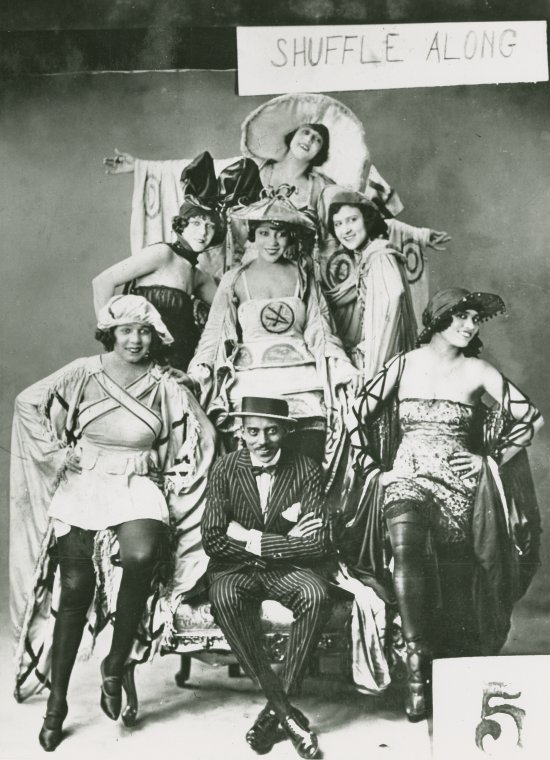
Noble Sissle and chorus in Shuffle Along in 1921.
Noble Sissle and Eubie Blake’s musical took Broadway by storm in 1921 — launching the careers of Josephine Baker, Adelaide Hall and Florence Mills, among others. After a three-month run on Broadway, the show came to downtown Brooklyn’s Montauk Theater (original cast and crew in tow, including famed trumpeter, Valid Snow) and remained, in one iteration or the other, well into the 1930s (one theater critic complained it was almost “impossible to get seats”)
Sissle and Blake followed “Shuffle Along” with “Shuffle Along of 1928” along with Sissle and Blake’s new all Black revue, “The Chocolate Dandies” at Werba’s Brooklyn Theater, and in 1932, opened yet another version of the production at The Majestic Theater, starring a young Lena Horne, and all the while, maintaining a 75 member cast plus orchestra.
One of the most notable imitations to follow Sissle and Blake’s hit was “Runnin’ Wild”, book and lyrics by Flournoy E. Miller and Aubrey L. Lyles (a comedy duo who had performed in “Shuffle Along”) as well as Fats Waller, with musical accompaniment by George Gershwin, James P. Johnson. Johnson, an African American pianist and composer and pioneer of stride piano, was one of the most important pianists in the early era of recording, one of the key figures in the evolution of ragtime into what was eventually come to be known as “jazz” music. A major influence on artists such as Count Basie, Duke Ellington, Art Tatum and Fats Waller (who was also his student) the musical was noted for its syncopated upbeat ebullience.
Broadway Back to Brooklyn
After a successful 224-night run on Broadway (and a brief run in Chicago),“Runnin’ Wild” came to “Werba’s Brooklyn Theater” in 1924. Scheduled for a single night’s performance, the sold out musical ran at Werba’s on Flatbush and Fulton four weeks. One critic wrote the show was “one of the brightest and funniest Ethiopian musical shows brought to the borough!”

Werba’s Triangle Theater, seen in 1915 at the corner of Flatbush and Fulton.
One of its dance numbers in particular, roused Brooklyn audiences to their feet as they literally attempted to join in. The dance number was of course, “The Charleston.” Soon, not only Brooklyn, but the world, joined in the music and choreography of celebratory Jazz Age, with African American musicals emphasizing the era’s social, artistic, and cultural dynamism. Ironically, in Sept. of 1928, the play “Porgy” (later to be adapted into the famous Gershwin musical “Porgy and Bess”) played for a week at Werba’s. Perhaps…just perhaps, Gershwin, who had been one of the few one members of the “Runnin’ Wild” collaborative team, got the idea to set “Porgy” to music while playing with “Runnin’ Wild”: Brooklyn’s Black Broadway.
Read more stories about local Black history in Fort Greene, by guest contributor Carl Hancock Rux, by clicking here.
Myrtle Black History: Music in the Greene [Part 2]
A Home for Jazz in Fort Greene
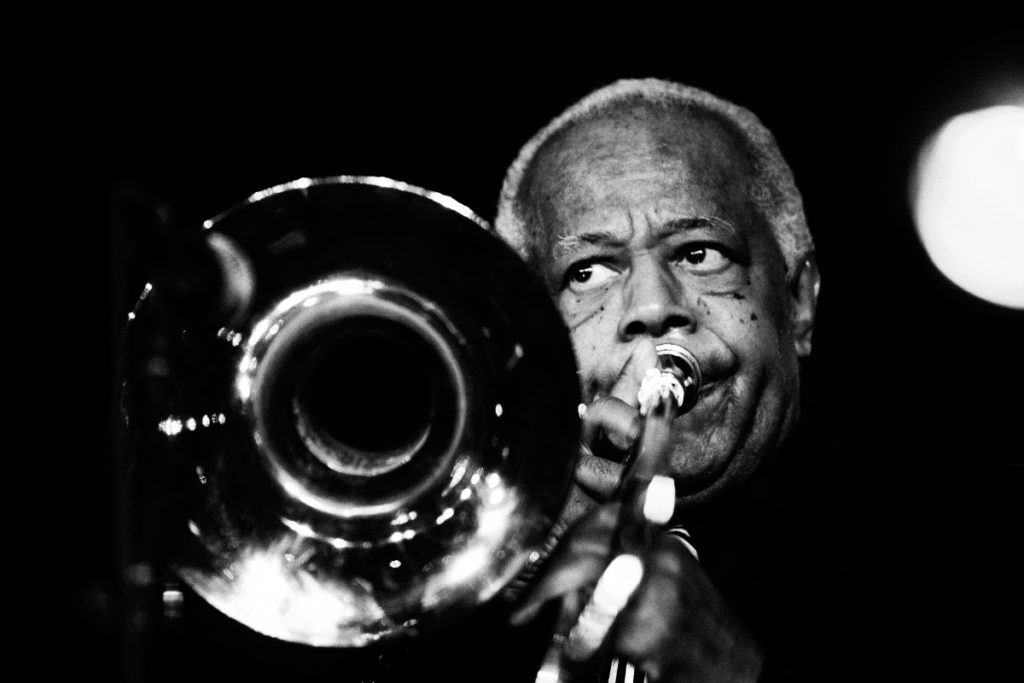
Fort Greene Jazz trombonist Slide Hampton. Image source: duna.cl
If you happen to walk anywhere within the vicinity of 245 Carlton Avenue in Fort Greene, you might hear the booming contemporary sounds of a live modern rock band, or you might hear the distant faraway complex harmonies and syncopated rhythms of a group of classic jazz musicians. The live rock music will most likely come from the teenager who lives there at present, rehearsing with his friends, to become the next great band. The jazz music, however, might actually be the result of your highly tuned auditory perception, delivering your inner ear to a musical inversion when actual jazz musicians routinely held jam sessions in that brownstone’s smoky rooms; taking the frenetic sounds of post-war be-bop and expanding them toward a modal approach reliant upon a tonal center of improvised chords. Pay close attention. You might actually be listening to Grammy Award winner Locksley Wellington Hampton (better known as “Slide Hampton”), Eric Dolphy, Freddie Hubbard, and Wes Montgomery—some of the most influential and groundbreaking jazz musicians of the 20th century who actually lived there from the late 1950s to the late 1960s.
SLIDE HAMPTON
Slide Hampton‘s distinguished career spans decades in the evolution of jazz. At the age of 12 he was already touring the Midwest with the Indianapolis-based Hampton Band, led by his father and comprising other members of his musical family. By 1952, at the age of 20, he was performing at Carnegie Hall with the Lionel Hampton Band. He then joined Maynard Ferguson’s band, playing trombone and providing exciting charts on such popular tunes as “The Fugue,” “Three Little Foxes,” and “Slide’s Derangement.” As his reputation grew, he soon began working with bands led by Art Blakey, Dizzy Gillespie, Barry Harris, Thad Jones, Mel Lewis, and Max Roach, again contributing both original compositions and arrangements. In 1959, Hampton and his wife, Althea, purchased 245 Carlton for $6,900. Less than three years after settling down there, Hampton formed the Slide Hampton Octet, which included stellar horn players Booker Little, Freddie Hubbard, and George Coleman. The band toured the U.S. and Europe and recorded on several labels.
From 1964 to 1967, he served as music director for various orchestras and artists. Then, following a 1968 tour with Woody Herman, he elected to stay in Europe, performing with other expatriates such as Benny Bailey, Kenny Clarke, Kenny Drew, Art Farmer, and Dexter Gordon. Upon returning to the U.S. in 1977, he began a series of master classes at Harvard, the University of Massachusetts at Amherst, De Paul University in Chicago, and Indiana University. During this period he formed the illustrious World of Trombones: an ensemble of nine trombones and a rhythm section. In 1998, Hampton received the Grammy Award for Best Jazz Arrangement with a Vocalist.
The 1990’s were spent doing an enormous volume of work. He continued to develop the Slide Hampton Quartet and Quintet, toured the world with the Dizzy Gillespie Alumni All-Stars, was a special advisor and arranger for the Carnegie Hall Jazz Band and arranged numerous recording projects around the world.
“(John Coltrane) used to come there all the time.” Hampton once told a reporter, “And Wayne Shorter used to live there. We had 13, 14 rooms in the house, right in Fort Greene [Brooklyn], right around the corner from Spike Lee’s father, [bassist] Bill Lee,”, continuing “a lot of musicians lived in that area. There were jam sessions and people practicing and rehearsing for years.”
Though Hampton and his wife would not sell 243 Carlton until 1985 (for $127,000) his countless collaborations over the years with the most prominent musicians of jazz afforded him a space where he could offer inexpensive rooms and impromptu rehearsal spaces for many of his jazz musician friends.
“245 Carlton Avenue–Eric Dolphy recorded a song on one of his albums called “245” , Hampton reminisced, “Robin [Eubanks, the acclaimed jazz fusion trombonist who would work with everyone from Sun Ra to Stevie Wonder to Art Blakey and the Jazz Messengers] used to live there, and his brother, Kevin [jazz fusion guitarist and composer; leader of The Tonight Show band with host Jay Leno and the short lived Jay Leno show] they both lived there.”
A HOME FOR JAZZ
In the mid to late 1960’s, newspapers routinely wrote about the Fort Greene/Clinton Hill as “the slums”; the area that had long forgotten its halcyon days of the Brooklyn Dodgers, candy stores, delicatessens, dairy cafeterias and trolleys where white working class “ethnics” once occupied its spacious brownstones. Boarded up, burning down, ripped open for African Americans, Hispanics and Asians, the community slipped into dismal decay. Several hundred thousand manufacturing jobs, and even more had left the area with the closing the of the Navy Yard, and Marianne Moore, famous 20th century modernist poet who had won every prize imaginable to man, had packed up her tricorn hat and long black cape, moving out of Cumberland Avenue apartment building (where she once entertained the likes of Gertrude Stein, Alice B. Toklas, Carl Van Vechten, E.E. Cummings, Ted Hughes, Sylvia Plath, Donald Hall, and Elizabeth Bishop) and returned to Greenwich Village.
Hardly newsworthy was the fact that Brooklyn’s downtown area was also becoming a well-known neighborhood where many jazz musicians began to live, including Grammy Award winning epicenter of ever given to the dingy if not cool jazz era of Fort Greene and Clinton Hill, where Grammy award winning jazz musician, Locksley Wellington Hampton, better known as Slide Hampton, lived at 245 Carlton Avenue between DeKalb and Willoughby. Hampton’s late night jazz sessions became so famous, Eric Dolphy titled an original tune—“245”– on his 1960 album “Outward Bound”. The area was once so renown for its resident jazz artists, musician Don Cherry titled his 1960 album, “Where Is Brooklyn?”
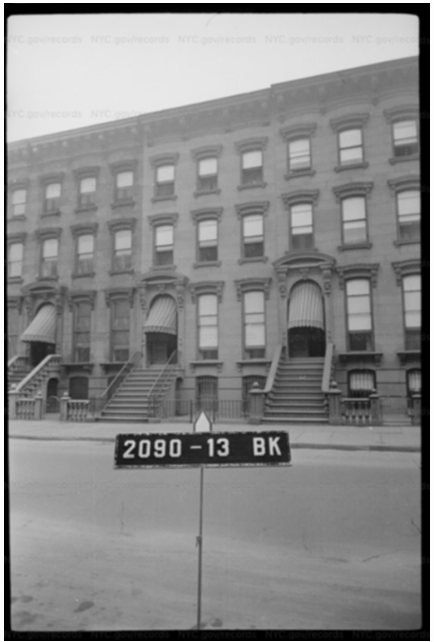
245 Carlton Ave, as seen in 1940. Credit: NYC Archives.
According to “Brooklyn Buzz, the house Hampton owned “between the 1950s and 1970s… remained a center of jazz activity and innovation.” Three of the genre’s biggest names—Eric Dolphy, Freddie Hubbard and Wes Montgomery—even created and lived together in its communal household. Slide says he had a big room in the basement, where he hosted jazz sessions. “And everybody came to those jam sessions,” he said. ” Gerry Mulligan and Bill Lee. A lot of musicians came because they always took any opportunity they could to come to a jazz session. That was very important at the time. ”The house has witnessed a backstage thread in jazz history that few know about. Jam sessions and non-stop talks about music influenced musicians that would expand the boundaries of each of their instruments.“ Slide was always very supportive of younger players like myself and very generous with tips on how to deal with the trombone,” said Jerry Tilitz, a trombonist, composer and vocalist originally from Brooklyn but presently residing in Hamburg, Germany“ It was a house full of musical inspiration,” said Hampton. “We were all composing music in some way. There was inspiration all over the place towards music and composition. Hampton, 89, an African-American trombonist whose career spans decades in the history of jazz, and brought him worldwide recognition, represents the influence of a definitive chapter of contemporary jazz and improvised music; a chapter dominated by bebop, a form of improvisation that emerged in the late 1940s led by Charlie Parker and Dizzy Gillespie.
BUILDING A MUSIC COMMUNITY
Hampton wasn’t the only jazz musician to have once lived in the area. The late Betty Carter, a Grammy award winning Jazz singer known for her improvisational technique, scatting and other complex musical abilities, vocal talent, and imaginative interpretation of lyrics and melodies, once owned 117 Saint Felix Street, where she lived from 1972 until her death in 1998. from 1984 until his death in 2018, Cecil Taylor, American avant-garde jazz musician and pioneer of free jazz, owned the house at 135 Fort Greene Place; and Lester Bowie, jazz trumpeter, composer; member of the Association for the Advancement of Creative Musicians and co-founder of the Art Ensemble of Chicago, and inductee into the Down Beat Jazz Hall of Fame, lived at 204 Washington where he died in 1999. For decades 135 Fort Greene Place was the home of renowned avant-garde jazz pianist Cecil Taylor and lived there until his death in 2018 at the age of 89. The Fort Greene, Clinton Hill area has also, at one time or another, been home to other great jazz musicians, including Max Roach, Randy Weston, Wynton and Branford Marsalis, Gary Bartz, Bill Lee, and contemporary jazz singers such as Carla Cook.
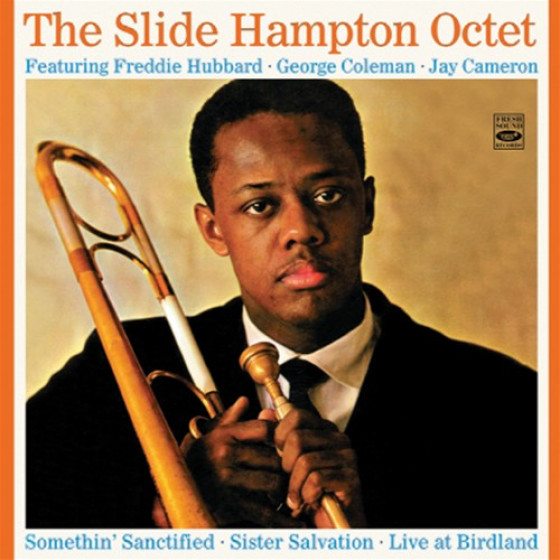
Slide Hampton 1961 album cover. Credit: Freshsoundrecords.com
Long before winning two Grammy Awards and the prestigious National Endowment for the Arts’ Jazz Masters Award, Hampton bought 245. The house, built in 1899, served as a harbor for a select group of jazz legends that at some point inhabited or visited this classic Fort Greene brownstone, where jazz sessions were routinely held. ”Everybody came to those jam sessions,” Mr. Hampton told an interviewer, ‘Gerry Mulligan and Bill Lee. A lot of musicians came because they always took any opportunity they could to come to a jazz session. That was very important at the time.” “Slide was always very supportive of younger players like myself and very generous with tips on how to deal with the trombone,” said Jerry Tilitz, a trombonist, composer and vocalist originally from Brooklyn but presently residing in Hamburg, Germany. In fact, there was a time when the Fort Greene , Clinton Hill area not only had famous jazz musician residents, but a number of legal and illegal jazz nightclubs as well. According to photographer, Jimmy Morton Sr., these all night haunts included “Tony’s”, a once favorite hang out spot where Max Roach, Miles Davis, Gig Gryce and Charles Mingus often played together. “Although [Monk] was playing at Tony’s, [Tony’s] could not advertise [Monk].”, Morton told a large crowd at the Weeksville Heritage Center, because he “didn’t have a cabaret license.:”
THE BAND PLAYED ON
From 1940 to 1967, the New York Police Department issued regulations requiring musicians and other employees in cabarets to obtain a New York City Cabaret Card, and musicians such as Chet Baker, Charlie Parker, Thelonious Monk, and Billie Holiday had their right to perform suspended at various nightclubs; a law that disproportionately affected the careers of many African American jazz musicians. Club owners were not allowed to advertise the appearance of artists without a license, and artists without a license were not allowed to perform in clubs where alcohol was served. Many black jazz musicians either toured Europe, or performed in underground clubs, in order to eke out a living, and survive on meager donations. Others used lofts, and other private homes in order to hold “word of mouth” parties where they could perform and earn a wage. Artists who performed at Tony’s on Grand Avenue & Dean St., included Etta Jones, Carmen McRae, and Arthur Taylor. Morton described the audience as “mostly local Brooklynites (and die-hard jazz) fans from France (as well as) American celebrities such as the famous gossip columnist, Dorthy Kilgallen.
Tony’s may have opened in the post war-period around 1952 and remained until 1955. Slide Hampton purchased his home around 1959, and moved on from the “Jazz House” at 245 Carlton Avenue in the early 1970’s. What can never be forgotten, however, is that post-WWII Fort Greene/ Clinton Hill (and its environs) is made up of more than the departure of a celebrated poet fleeing its “slum” history; it was also home to some of the greatest jazz musicians in music history. Listen closely. You might just hear them playing, “Don Cherry’s “Where’s Brooklyn?” or, Slide Hampton and his housemates, Freddie Hubbard, Eric Dolphy and Wes Montgomery joined by Jackie Byard, George Tucker, and Roy Hynes, playing Dolphy’s “245” with bursts of incendiary genius seemingly conjured out of nowhere: that music always round you, unceasing, unbeginning, ascending buoyantly through the best of times, the worse of times and times yet to come.
Read more stories about local Black history in Fort Greene, by guest contributor Carl Hancock Rux, by clicking here.
Myrtle Black History Spotlight: Sarah Garnet

A Seat At the Table: Sarah Garnet
by Carl Hancock Rux
Winter’s civil twilight burnished the East River of Wallabout Bay, bringing a fresh wet cold inland off the semicircular bend of the river. January’s chill swept through the coal bunkers and the old ventilating plant, whipping around Johnson Street, from Bridge Street to Hudson avenue, climbed south uphill from Bolivar eastward through the wood-slat houses of North Portland, pressing uphill blocking the drainage systems with snow and ice, so that the entire accumulation of water, not only from the yard but from the streets above, stood in large pools of water, iced over. Sarah Garnet stood at the top of her stoop under the archway entrance of her home, supervising the shoveling of snow and ice– firmly grasping a turn-over collar at her throat, and the long winter sinner coat wrapped around a black mohair brilliantine dress he’d made herself. Shutting her doors against the frigid air, she delighted in the warmth of her house at 205 DeKalb Avenue, and the fact that she, a 71-year-old retired Black public school teacher; first African American woman public school principal; and outspoken suffragist, Mrs. Garnet, who had lived long enough to witness the emancipation of enslaved colored men and women, undoubtedly anticipated the arrival of her honored guests, and her continued participation in the discourse regarding education, economy, race, politics, and gender.
As an era of newly gained and quickly vanished civil rights for African Americans, lynching, racial violence, and slavery’s twin—sharecropping—arose as deadly quagmires on the path to full citizenship. After Reconstruction ended in 1877, the federal government virtually turned a deaf ear to the voice of the African American populace. Yet in this era Blacks were educated in unprecedented numbers: hundreds received degrees from institutions of higher learning, and a few, like W.E.B. Dubois and Carter G. Woodson, achieved doctorates. While only a small percentage of the Black populace had been literate at the close of the Civil War, by the turn of the twentieth century, the majority of all African Americans were literate, demonstrating much progress for African Americans in the last decades of the nineteenth century. Some African Americans, had chosen to leave the United States altogether. In the words of her late second husband, Henry Highland Garnet, “The nation has begun its exodus from worse than Egyptian bondage… let us not pause until we have reached the other and safe side of the stormy and crimson sea. Let freemen and patriots mete out complete and equal justice to all men, and thus prove to mankind the superiority of our Democratic, Republican government.”
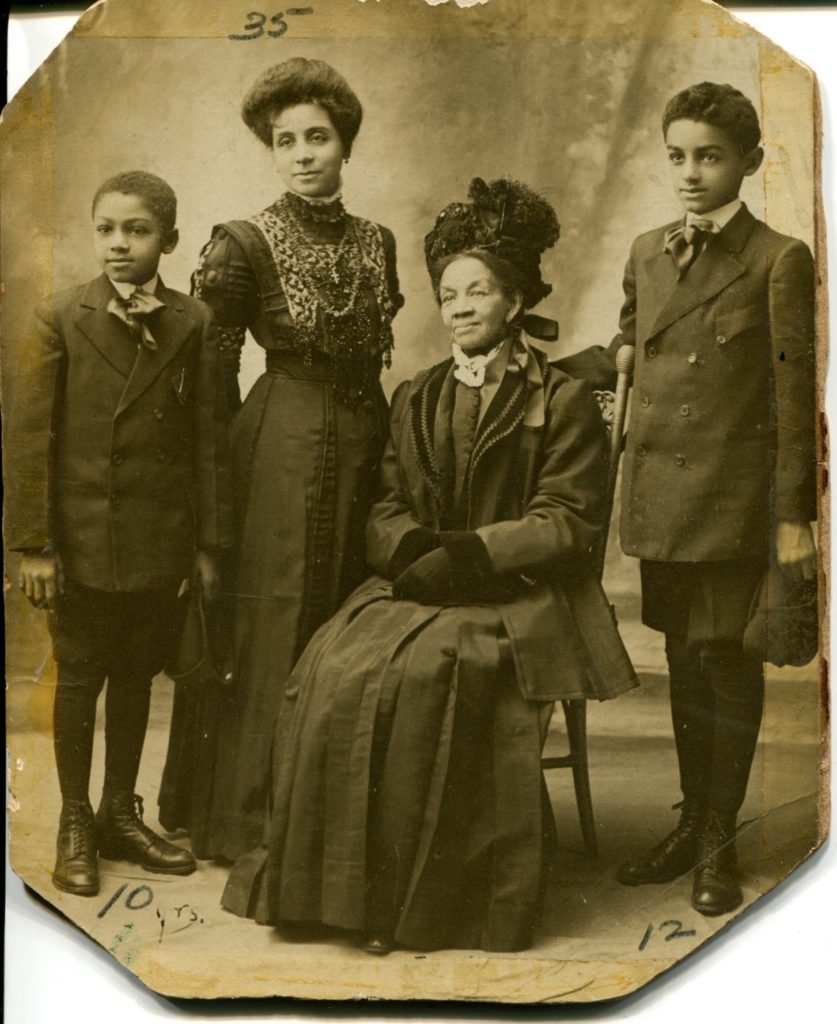
A LIFE IN EDUCATION
Mrs. Garnet, however, did not seem to share her late husband’s sentiments. Her late husband had been born a slave in Maryland and, along with his family, secured his freedom in 1824, arriving in New York City in 1825, two years before the abolition of slavery in New York State. Highland Garnet entered the African Free School on Mott Street in 1826. There he met and formed lifelong friendships with James McCune Smith and Alexander Crummell, among others. In 1834, Garnet and some of his classmates formed the Garrison Literary and Benevolent Association. Perhaps drawing on his studies in navigation and seamanship at the New York African Free School, Garnet made two sea voyages to Cuba in 1828. After another sea voyage in 1829, he returned to learn that his family had separated in the hopes of escaping slave catchers. Enraged and worried, Garnet wandered up and down Broadway with a knife. Eventually friends were able to locate him and spirit him off to Long Island to hide. Garnet is perhaps most famous for his radical speech of 1843, “An Address to the Slaves of the United States of America, urging enslaved African Americans to rebel against their masters.” Frederick Douglass, who was still committed to abolitionist William Lloyd Garrison’s approach of moral suasion, spoke out against the speech, while James McCune Smith expressed admiration for it. Garnet further radicalized his position when he supported the colonization movement, which was largely unpopular among the black community. Garnet moved to England in 1850 where he continued to speak on abolitionist themes. He went to Jamaica as a missionary in 1852. In 1859 he founded the African Civilization Society and in an 1860 speech wrote of his belief that “Africa is to be redeemed by Christian civilization.” Because of Garnet’s outspoken views and national reputation, he was a prime target of a working-class mob during the July 1863 draft riots in New York City. Rioters mobbed the street where Garnet lived and called for him by name. Fortunately several white neighbors helped to conceal Garnet and his family. On February 12, 1865, Garnet became the first black person to deliver a sermon in the House of Representatives where he uttered the words quoted in the second paragraph of this article.
With his second wife, Sarah Garnet (and her accomplished younger sister) he helped found the Brooklyn based Equal Suffrage League , and served as superintendent of the Suffrage Department of the National Association of Colored Women. Appointed the U.S. Minister (ambassador) to Liberia, where he arrived on December 28, 1881, Garnet, suffered periods of physical and mental decline and expressed a great wish to die “on African soil” in Liberia, where his daughter Mary Garnet Barboza had been laid to rest years earlier. Henry Highland Garnet died February 13, 1882, of malaria, was given a state funeral by the Liberian government, and buried at Palm Grove Cemetery, in Monrovia.
FIGHTING FOR CIVIL RIGHTS
The widow Garnet, however, still had much work to accomplish for her people and her gender on American soil There were many Black men and women who, like herself, were committed to influencing an entire nation to fully realize its supposed democracy. African American women like Sarah Garnet, had long played a major role in the civil rights of African Americans. There would have to be a full commitment to the arduous work to secure civil rights and equality, no matter how many proclamations, court rulings or protests there might be.
Looking at her table, stretched long across her dining room, Sarah Garnet glanced out of her parlor floor window, peering into the cold iciness of dusk, and the slow, arduous shoulders of a few of her guests braced against the wind, making their way uphill. Yes, it might be a long and difficult road to achieving full civil rights and equality for all, but it was worth the battle, if just to secure a seat at the table. Born Sarah Jane Smith in 1831, she was the eldest child of Sylvanus Smith, a wealthy Brooklyn pork merchant (described in an 1874 Brooklyn Daily Eagle article as “a colored gentleman” and “leading light in the congregation of the First Precinct” who lived at 247 Pearl Street and was reported “rich among the colored population of Navy Street and vicinity”.) and his wife, Ann Springstead Smith. Her father was one of the earliest landowners of Carrsville, (a neighboring settlement to Weeksville, Brooklyn), established a decade or so before the Civil War, comprised of successful African Americans with full voting rights who built their own churches, schools, charities and businesses (in other newspaper accounts, her father is also described as a “colored gentlemen” and “leading light in the congregation of the First Precinct”, who resides at 247 Pearl Street; is reported to be “rich among the colored population of Navy Street and vicinity”; and as early as 1842, Sylvanus Smith is also mentioned as one of ther trustees of of Colored School No. 1 on Nassau Street, near Jay Street; and the following year, as belonging to a group of trustees who petitioned the Brooklyn courts for an appropriation to purchase ground for the erection of a “Colored School”; in 1874, he is also mentioned as having been arrested for “operating an ailing horse”, and faced with imprisonment of 25 days in the Raymond Street Jail, immediately paid a ten dollar fine from his own pocket, a sizeable sum at the time).
![Where's Waldo? Williamsburg landmarks you should find [node:title] | [site:name]](https://brooklyneagle.com/wp-content/uploads/2016/09/colored-school-number-3.jpg)
Colored School No. 1 in Williamsburg.
THE RIGHT TO VOTE
Sarah Garnet, a committed suffragist, belonged to an unofficial sorority of African American women in the late 19th century, well into the early 20th century, who overcame the conditions of freedom, race, and gender forced upon them, not least of which was a period of exacerbated racismin the Uniuted States—with the loss of African Americans’ political rights and the Plessy v. Ferguson Supreme Court decision—and reaffirmation of woman’s inferiority at the turn of the century. Most black women had to adopt ways of being women and citizens that were distinctive from their white counterparts’ and not always in keeping with Victorianism as defined in the early nineteenth century, but marked by the experience of exclusion and the challenge of meeting adversity. Also belonging to this inner circle of educated, sel-made, wealthy, African American women was Sarah Garnet’s younger siuster, Dr. Susan McKinney-Steward, the third African-American woman to earn a medical degree in the United States and the first to do so in New York State. Dr. McKinney-Steward, found her calling in medicine after her brother’s death in the Civil War and a cholera epidemic that swept through New York City in 1866 and claimed the lives of 1,137 people. Though the daughter of a wealthy pork merchant, she paid her own way through medical school by offering singing lessons and graduated valedictorian. After receiving her degree, she achieved wealth and a local reputation as a successful Brooklyn physician with an interracial clientele, specializing in pediatric care and the treatment of childhood diseases. Outside her medical practice, she agitated for social reform, advocating female suffrage and temperance. Until the early 1890s, she remained the organist for the African Methodist Episcopal (AME) church where she regularly worshiped. Both of McKinney-Steward’s husbands were ministers. She was married to South Carolina minister William G. McKinney in 1871, until his death in 1894. McKinney Steward shared the home of her sister, Sarah, at 205 Dekalb Avenue, departing shortly after the death of her first husband, and her subsequent marriage in 1896 to Dr. Theophilus Steward, American author, educator, clergyman, U.S. Army chaplain, Buffalo Soldier of 25th U.S. Colored Infantry, and an ordained minister in the African Methodist Episcopal Church. (The Stewards would eventually settle in Ohio where both received appointments to teach at Wilberforce University, America’s first college to be owned and operated by African Americans).
The evening of Jan. 11th, 1902, Mrs. Garnet’s party party would be presided over by the toastmaster, Frederick R. Moore, editor and publisher, who worked closely with Booker T. Washington to promote the National Negro Business League; and editor and publisher of the Colored American Magazine, the most important African American newspaper in the United States. The chairman of the dinner would be prominent African American inventor, engineer, and inventor, Samuel R. Scottron, graduate of Cooper Union; community leader and outspoken advocate of trade education; advocate of racial harmony and fairness; public speaker and writer on race relations who had fought for the end of slavery of slavery in Cuba and Puerto Rico. In 1894, Sottron was appointed to the Brooklyn Board of Education and served as its only African American member for the next eight years (a staunch opponent of the segregation of the public school system, (a controversial topic in 1902 for both blacks and whites. When Sarah Garnet (nee Tompkins) began teaching in 1854, the public schools were racially segregated, including her school, the African Free School of Williamsburg; she took over leadership of Grammar School Number 4 on April 30, 1863. Now, the Sarah Smith Garnet school, P.S. 9, is located in another historic district Brooklyn’s Prospect Heights.)
The guest of honor: William F. Powell (U.S. Minister to Haiti, and Charge d’Affaires in Santo Domingo. Powell, a former Brooklynite, rose to prominence in New Jersey as a teacher and educational leader and attracted the attention of several presidents of the United States who offered him opportunities to become an American envoy. After rejecting two consular assignments, he not only served as a diplomat to Haiti but to the Dominican Republic.
Having attended public schools in Brooklyn, New York, and Jersey City, New Jersey, as well as the New York School of Pharmacy and Ashmun Institute in Pennsylvania (later known as Lincoln University) as well as the New Jersey Collegiate Institute (NJCI). In 1865, Powell graduated from NJCI and began his career as an educator when the Presbyterian Board of Missions hired him to teach at an African American school in Leesburg, Virginia. One year later, in Alexandria, Virginia, Powell founded a school for African American children and led the school for five years. Powell became principal of a Bordentown, New Jersey, school in 1875. In 1881, he interrupted his career as an educator and was employed as a bookkeeper in the Fourth Auditor’s Office of the United States Treasury. In 1881, Powell was offered a diplomatic assignment in Haiti, but he rejected it.
In 1884, Powell resumed his career as an educator when he became superintendent of schools in the fourth district of Camden, New Jersey. Under Powell’s leadership, attendance increased, manual training was included in the curriculum, and a new school for industrial education was built. In 1886, Powell relinquished his position as superintendent and taught at Camden High and Training School, a predominantly white school. This career move probably made Powell one of the first African Americans to teach in a predominantly white school in Camden as well as the rest of New Jersey. He remained at Camden High until 1894. He rejected a second diplomatic appointment in 1891 during the administration of Benjamin Harrison, the 23rd president of the United States.
In 1897, President William McKinley appointed Powell as the United States minister to Haiti, a position traditionally given to prominent black Republicans. One of Powell’s main goals in Haiti was to promote American business interests. He was very effective in his efforts to encourage U.S. business investments in the copper, railroad and timber industries. Powell also supported the educational work of Booker T. Washington by lobbying Haiti’s government to embrace the model of Tuskegee Institute for Haitian youth, and was very effective in his efforts to encourage U.S. business investments in the copper, railroad and timber industries. At the end of his tenure in Haiti, Powell had survived a planned assassination, and upon returning to America, belonged to a small but elite group of African American New Yorkers, which included Sarah Garnet and her late husband, Henry Highland Garnet, who despite their material comfort, stood at the vanguard of the fight for black civil rights.
In 1907, five years after the dinner party at Sarah Garnet’s home at 205 DeKalb Avenue, the Equal Suffrage League and the NACW (the organization Sarah J. Garnet had founded founded years earlier with her late husband and her dear sister, Dr. Susan McKinney-Steward) jointly supported a resolution supporting the principles of the Niagra Movement that advocated for equal rights for all American citizens. Four years later, Sarah Garnet traveled with her sister, Dr. Susan McKinney-Steward, to attend the inaugural Universal Races Congress of 1911, in London, England, where Dr. McKinney- Steward presented the paper “Colored American Women”. W. E. B. Du Bois also attended the conference.
Shortly after returning to New York, Sarah Garnet died on Sept. 11th, 1911, her organization for the equal rights for all Americans, dying with her. It’s mission, however, would continue for more than a century. Nine years later, after much agitation, most women received the right to vote in America. Though theoretically “equal before the law” after the nation’s emancipation proclamation of 1865, many African Americans, however, were effectively barred from voting until the passage of the Voting Rights Act of 1965–forty-six years after Mrs. Garnet’s death. On Nov. 7th, 2020, the night United States Senator Kamala Harris was officially recognized as Vice President Elect of the United States of America, she acknowledged in her victory speech the long battle women had faced for the right to vote and to break into the highest ranks of American politics. In her acceptance speech, she acknowledged that African Americans, and especially African women, like herself, had “too often overlooked, but so often proved that they are the backbone of our democracy…” “While I may be the first woman in this office, I will not be the last,” Harris said. “Because every little girl watching tonight sees that this is a country of possibilities.”
FORT GREENE LEGACY
Perhaps that night, as the community of Fort Greene, Brooklyn, erupted in celebration, the Victorian house at 205 DeKalb Avenue (presently under renovation for its new occupants), braced itself against the autumn chill, confidant the nation was also “under renovation”, and the work of race and gender had finally reached an important inflection point in American politics: knowing the fundamental education of African American children, yet to come, had finally found its foundation. Sarah Garnet, and the many black men and women like her, had finally won a seat at the table of America.
Myrtle Black History Spotlight: DR. Susan McKinney
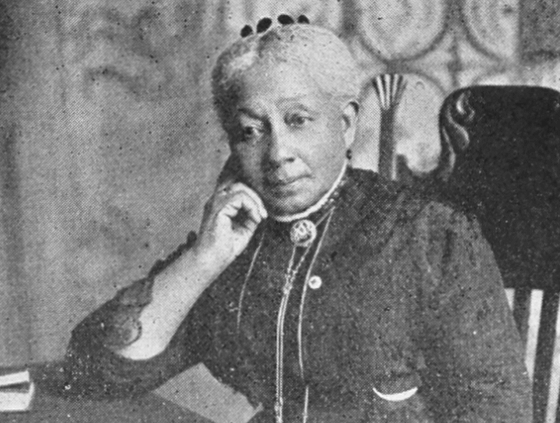 MARRIED TO MEDICINE: THE LEGACY of DR. SUSAN SMITH McKINNEY STEWARD
by Carl Hancock Rux
Harlem Renaissance writer and anthropologist, Zora Neale Hurston once famously wrote, “Research is formalized curiosity. It is poking and prying with a purpose. It is a seeking that he who wishes may know the cosmic secrets of the world and they that dwell therein.”
Perhaps no one knew that better than 74 year old William McKinney, a retired schoolteacher, who having spent 10 years of his life working tirelessly to gain some recognition for his grandmother to be honored as Brooklyn’s first black woman physician. Susan Maria Smith McKinney Steward (March 1847 – March 17, 1918) was an American physician and author. She was the third African-American woman to earn a medical degree, and the first in New York State.[1]
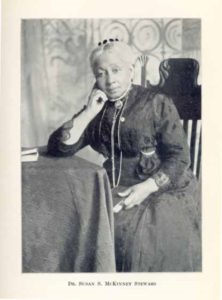 A MEDICAL PRACTICE GROWS IN BROOKLYN
McKinney-Steward’s medical career focused on prenatal care and childhood disease. From 1870 to 1895, she ran her own practice in Brooklyn and co-founded the Brooklyn Women’s Homeopathic Hospital and Dispensary.[2] She sat on the board and practiced medicine at the Brooklyn Home for Aged Colored People. From 1906 she worked as college physician at the African Methodist Episcopal Church’s Wilberforce University in Ohio. In 1911 she attended the Universal Race Congress in New York, where she delivered a paper entitled “Colored American Women”. A retired schoolteacher and resident of St. Albans Queens, Mr. McKinney no doubt was aware that his grandmother served as a physician in Brooklyn for 26 years, starting in 1870. From 1964-1974, 74-year-old William McKinney’s research into Dr. McKinney’s career took him to the records of the Long Island Historical Society and the Medical Society of the County of Kings. He also found references to Dr. McKinney in Stiles’ History of Kings County, in the Medical and Surgical Register of the United States of 1890, and in Brooklyn directories from 1871 to 1896. He then began a campaign to honor his grandmother, sending letters to both the central office of the Board of Education and local school board.
Dr. McKinney was the daughter of Sylvanus Smith, a prominent Brooklyn pork merchant and abolitionist who engaged himself in spearheading Brooklyn’s anti–slavery movement which began in the neighborhoods we now call DUMBO and Vinegar Hill. At the end of the American Revolution, this was the town of Brooklyn. It was one of six agricultural towns in Kings County until it was incorporated as the city of Brooklyn in 1834. From 1810 onwards, this area was home to a self– determined free black community. The community built independent institutions to meet, study, pray, and combat the widespread racism around them. They established a powerful anti–slavery agenda for future generations of activists. In 1838 eleven years after New York finally abolished slavery. Sylvanus Smith and other African Americans, including Peter and Benjamin Croger, William Wilson, James Pennington, James and Elizabeth Gloucester, and William and Willis Hodges, lived in the communities of Williamsburg, Fort Greene, and Cobble Hill. They gave up their urban existence to create a small middle-class farming community which they called Weeksville (named after James Weeks, an African American settler from Virginia who was the earliest landowning resident in the area.) Farming was only part of the motivation for the Weeksville settlement. By purchasing land, the families ensured that they met the $250 property requirement for voting established by the 1821 New York State Legislature solely for black males in the state.
Weeksville is now part of Bedford-Stuyvesant, and the Weeksville farm of Sylvanus and Ann Springstead Smith was at the corner of what is now Fulton Street and Buffalo Avenue. Smith was also committed to African American educational achievement as a means to improve the community’s social status. He sat on the board of trustees for the African American Free School of Brooklyn, also known as Colored School No. 1. The school was founded on November 2, 1787, and subsequently opened in 1795. Its mission was to provide education to children of slaves and free people of color. Its leaders also advocated the full abolition of African slavery. Sylvanus Smith and his wife Ann Springstead Smith had seven children.
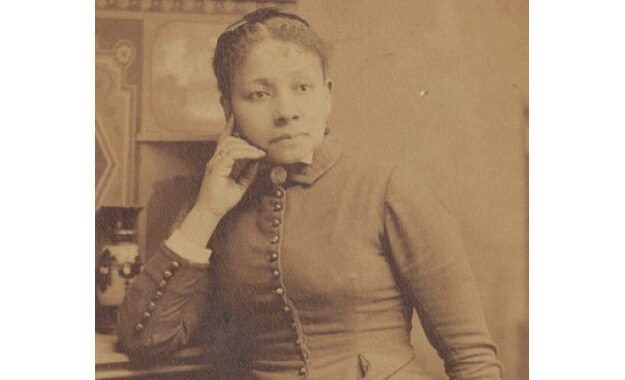
A FAMILY LEGACY
Two of their daughters, Susan Smith McKinney-Steward and Sarah Smith Thompson Garnet, later became prominent citizens in their own right. The Smiths instilled the value of education and social activism in both their daughters. Smith’s social status allowed his children access to a quality education. Susan and Sarah were both educated in the classics and music.
Susan Smith was born in 1847 in what was then known as Crow Hill, Brooklyn (today as Crown Heights), arguably named so because the area was once the site of a small outpost of shanties and piggeries known as Crow Hill.
It’s main landmark: the imposing Brooklyn Penitentiary, sometimes called the Crow Hill Penitentiary, which stood on Carroll Street between Nostrand and Rogers Avenues from 1846 until 1906. An 1877 Brooklyn Eagle article states, “The name Crow Hill was derived from the fact that in the trees which are scattered over this ridge, crows, who preyed on the neighboring farmers, found a retreat. ”Other sources say the penitentiary inmates were also referred to as crows. Then there’s a third explanation: most historians agree that the name Crow Hill was coined in derogatory reference to the black community of Carrville and Weeksville, whose residents were sometimes known as “crows.”
OFF TO COLLEGE
She was was the first African American woman to be admitted to the New York Medical College for Women in 1867, having paid for her tuition out of her own savings) and earned her M.D. in 1870, a student under Dr. Clemence Sophia Harned Lozier, (December 11, 1813 — April 26, 1888) an American physician who founded the New York Medical College and Hospital for Women; noted feminist and activist, and president of the New York City Suffrage League and the National Women’s Suffrage Association. It would have been no accident that Dr. McKinney Steward would become the third African-American woman to earn a medical degree, and the first in New York state under Dr. Lozier.
Dr. Lozier, taught hygiene and anatomy which she learned from her older physician brother. He also helped guide her interest in medicine into her late thirties. She was one of the first teachers in the city to introduce the study of Psychology, Hygiene and Anatomy as branches of the female education. [5At the time, these topics were not included in women’s education, and her classes quickly expanded. Among other topics, she educated women on the physiological consequences of fashion, like the deformities and breathing problems caused by corsets. She continued to teach these classes until 1843, and soon after, moved to New York and continued giving lectures and visiting the sick. Her first husband died in 1837, and she later remarried to John Baker in New York. After her husband’s death in 1837, Lozier continued with her medical training which she desired to devote herself…Lozier attended Plainfield Academy and learned about medicine from her mother and brother as well as from caring for her ill husband.[6] She wished to attend medical school, but women were not accepted at the time, so her brother continued to tutor her. [She continued to apply to medical schools and experienced a lot of rejection, even from Geneva Medical College, which was attended by Elizabeth Blackwell, the first woman in the U.S. to achieve a medical degree in 1849. Eventually, she was allowed to attend classes at Central New York College of Rochester in 1849, and was later admitted to Syracuse Eclectic College.[4] In 1850 the Central Medical College of New York moved to Rochester and became Rochester Eclectic Medical College. In 1849 the Eclectic Medical Institute merged with Randolph Eclectic Medical Institute and moved to Syracuse to become the Central Medical College of New York, which agreed to admit Lozier as a medical student.
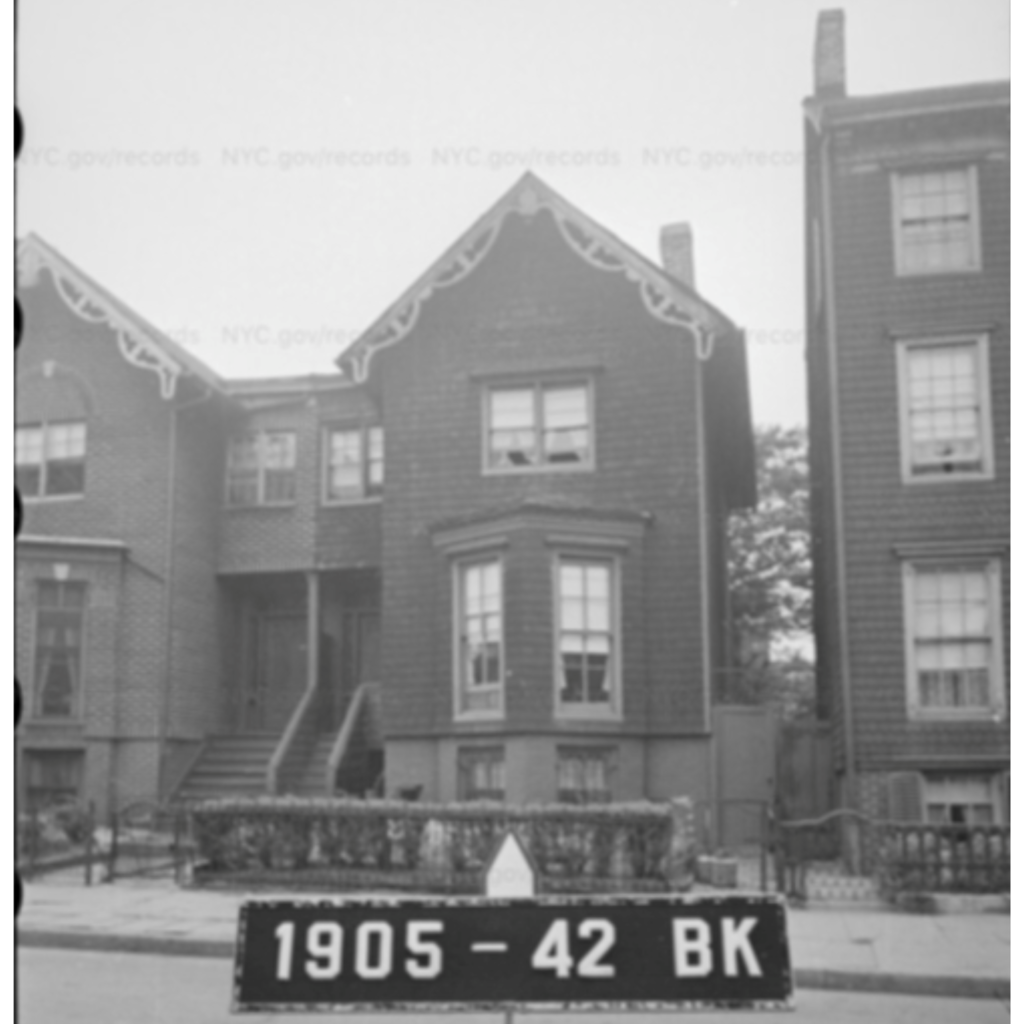
McKinney’s former home on Ryerson between Willoughby & Myrtle Aves, where Willoughby Walk Co-ops now stand.
A HOMEOPATHY APPROACH
The differences between orthodox medicine and homeopathy could hardly be more vivid. From its beginning homeopathy always began with a long consultation, lasting at least an hour, in which all aspects of the patient’s illness and life were discussed—homeopaths like to stress that they practice ‘holistic medicine’—and the appropriate treatment chosen. In contrast, during the first half of the nineteenth century, when homeopathy was becoming established, orthodox medicine was immersed in the belief that advances in understanding disease could only come from a detailed correlation of symptoms and signs of the sick patient on the ward, and the findings at autopsy: clinico-pathological correlation. As Bichat famously put it put it at the very end of the eighteenth century:‘ For twenty years from morning to night you have taken notes at patients’ bedsides… which, refusing to yield up their meaning, offer you a succession of incoherent phenomena. Open up a few corpses: you will dissipate at once the darkness that observation alone could not dispel.’8
Clinico-pathological correlation demanded the understanding of a very long and complex collection of diseases accompanied by heated debates between the contagionists and the anti-contagionists. This was way beyond the comprehension of the general public. Moreover, medical treatment was to a large extent crude and ineffective, consisting largely of potentially dangerous polypharmacy, purging, and profuse blood-letting.
Hahnemann showed no interest in detailed pathology, and none in conventional diagnosis and treatment. He was only interested in the principles of homeopathic medicine which he used to name the illness.2 Classical homeopathy was therefore seen by its supporters as an attractively safe system, simple, easy to understand, and centered on the patient as a whole and not on pathological lesions. This goes a long way to explain why homeopathy was popular.9
But there was one aspect of homeopathy which, from the time it was first announced in about 1814, led to open warfare between orthodox medicine and homeopathy. This was the result of Hahnemann’s belief that drugs should be given in a dose which only just produced the slightest symptoms of the disease which was being treated. Whereas Hahnemann claimed that homeopathy could cure all or virtually all diseases, his followers modified these claims in the hope of becoming accepted by orthodox medical practitioners. One of the first institutions devoted to homeopathy was the American Institute of Homeopathy, founded at the end of the nineteenth century, when it seems that ‘a rapprochement between homeopaths and conventional physicians gradually unfolded. Homeopaths adopted new orthodox treatments… while allopaths [regular orthodox physicians] borrowed homeopathic remedies… In 1903, after long antagonism, the American Medical Association… invited homeopaths to join [the Association].’9 The Food, Drug and Cosmetic Act of 1939 in the USA allowed homeopathic medicines to be sold openly on the market. Five homeopathic hospitals were founded in Britain, the two largest (in London and Glasgow) having in-patient units. Today the ten most common diseases treated by homeopaths are (in order of frequency) asthma, depression, otitis media, allergic rhinitis (hay fever), headache and migraine, neurotic disorders, non-specific allergy, dermatitis, arthritis and hypertension.
There seems little doubt there has been a remarkable revival of homeopathy since the 1960s and 1970s in many countries, but especially the USA where, in 2002, it was estimated that the number of patients using homeopathic remedies had risen by 500% in the previous seven years, mostly by purchasing over-the-counter remedies. In the USA patients seen by homeopaths tended to be more affluent, more frequently white, present more subjective symptoms, and to be younger than patients seen by conventional physicians.
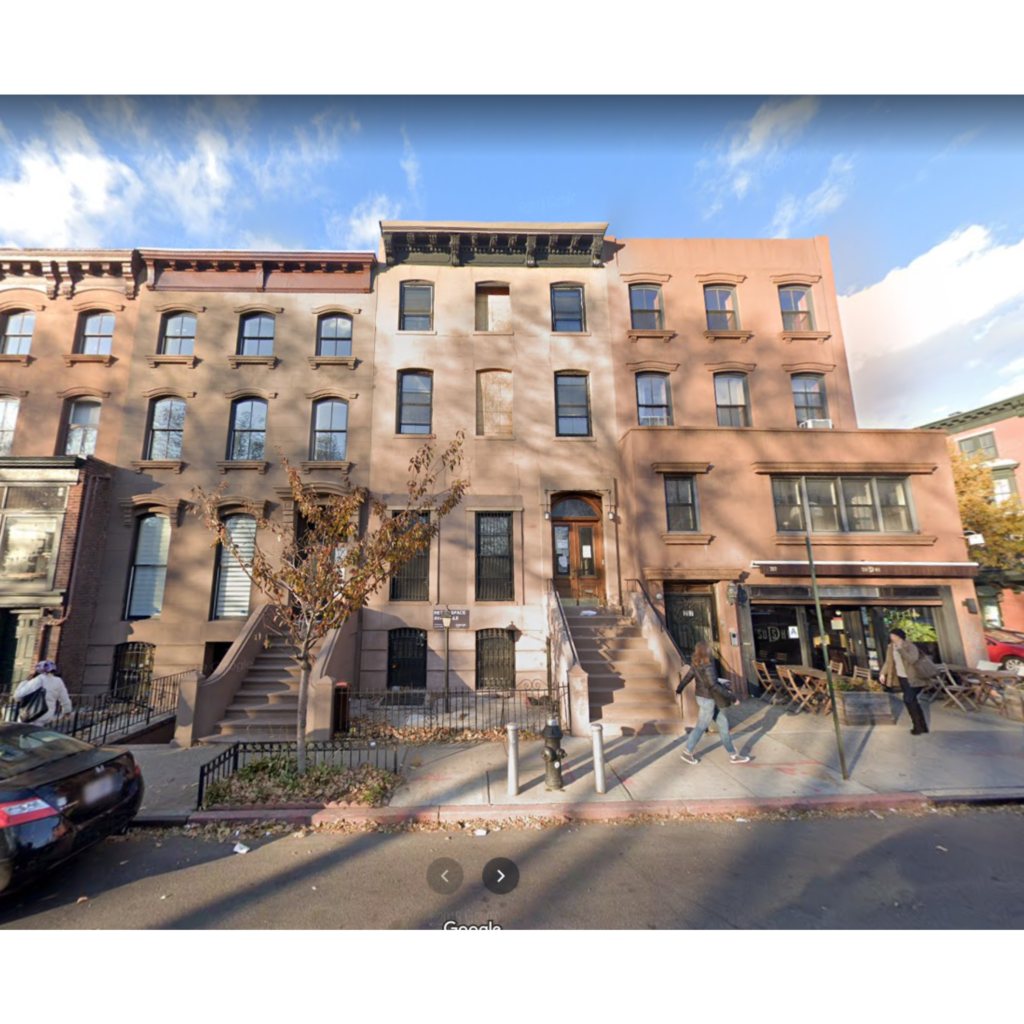
McKinney’s former home and medical office at 205 DeKalb in Fort Greene
BACK TO BROOKLYN
Graduating as valedictorian of her class, and after eight years of practice in a culture prejudiced against women physicians (and certainly African American women) was able to maintain two offices in both Brooklyn and Manhattan, both servicing Blacks and whites alike. As such, she joined a handful of black women physicians who emerged in the Reconstruction period and become the first African-American woman in New York State to earn a medical degree, and the third in the United States. Described in the Brooklyn Daily Eagle as a woman whose home (and practice) was at 178 Ryerson St., (a home “leaving nothing to be desired neither in comfort and tasteful surroundings”, shared with her husband, Rev. W. G. McKinney, “ a colored Episcopal clergyman with literary aspirations; their children and her widowed mother”) Dr. McKinney Steward was further described as “ a well to do woman” both “self-sustaining and consequently helpful to others”, as well as being “three fourths white… good-looking, possessing a strong face… whose attire was modest, and Individual, having a true appreciation of dress and its importance (thus rendering her) a lady in manner, quiet and self-contained, and evincing in her conversation the culture and refinement of the true woman. Brooklyn ought to be proud of having among its physicians the first colored woman graduate of any medical college in America. This is a distinction, for in this country there had been a prejudice against her race, not known in European countries. Were she in Edinburgh or London or Paris, she would have become famous with the same results that she has won here, step by step, and in one of the most closely contested efforts that social custom and ingrained prejudice—the result of slavery—could combine to prevent success. Yet, she has won it, and won it in a truly womanly and se sensible fashion, by sheer industry and unflagging will.”
She practiced as Dr. Susan Smith in Brooklyn from 1870 to 1873. One year later, she married Rev. William G. McKinney and practiced in Brooklyn as Dr. Susan Smith McKinney until 1896. In 1882, she was a member of the New York Medical College and Hospital for Women at 213 West 54th Street, between Broadway and Seventh Avenue in Manhattan. In 1881, she became one of the founders of the Women’s Hospital and Dispensary at Myrtle and Grand Avenues in Brooklyn and remained on the staff of this hospital until 1895. In 1887, Dr. McKinney took a postgraduate course at the Long Island Medical College and Hospital in Brooklyn, where she was the only woman student. She also served as official physician at the Brooklyn Home for Aged Colored People.
Active in community life, according to her grandson, Dr. McKinney also was organist and choir director at the Bridge Street A.M.E. Church for 28 years. Having been taught to play the organ by the Plymouth Church organist. Dr. McKinney first practiced medicine at 243 Pearl Street, later at her homes at 178 Ryerson Street, and later, 205 DeKalb Avenue. She was one of the founders of the Women’s Hospital and Dispensary at Myrtle and Grand Avenues and was a staff member there until 1895. She also was an official physician at the Brooklyn Home for Aged Colored People. In Sept. 1974, Sands Junior High School in the Brooklyn (NY) Navy Yard section was renamed in honor of Dr. Susan Smith McKinney Steward. Among the many attendants at the renaming ceremony was her 74-year-old grandson, William McKinney, whose formalized curiosity resulted in revealing just one of many cosmic secrets of the world and they that dwell therein.
Lewis Latimer & The Invention Of Electric Light
“Like the light of the sun, it beautifies all things on which it shines, and is no less welcome in the palace than in the humblest homes” –
Lewis Latimer 1891
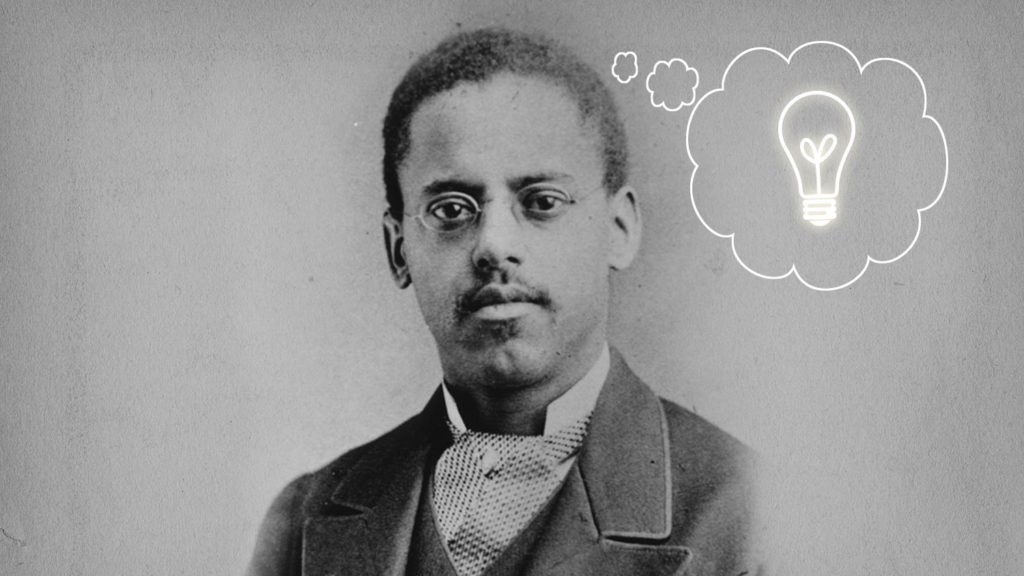
Lewis Latimer
Thomas Edison is widely recognized the world over as the inventor of the light bulb, but the story is much more complicated than that. African-American inventor Lewis Latimer drew the first electric light blueprints and patented the method for making carbon filaments, allowing light bulbs to burn for hours instead of minutes. Lewis Howard Latimer was born in 1848. He was an African American inventor and innovator in the electric lighting industry.
His parents, George and Rebecca Latimer, escaped slavery in 1842, journeying from Virginia to Massachusetts. When George’s owner showed up in Boston to reclaim his property, the organized abolitionist movement there rallied in full force, making the Latimer case the cause celebre of their mission, starting the Latimer Journal and North Star to keep the public abreast of the case and raising the money to purchase his freedom. The case leads to a petition, signed by 65,000 citizens of the Commonwealth, insisting that a law should be passed forbidding the State of Massachusetts from detaining fugitives from slavery and that amendments to the Constitution of the United States be proposed by the legislature of Massachusetts to definitively separate the people of Massachusetts from all connection with slavery. The petition did result in such an act, effective for the State, but was ultimately unsuccessful at the Federal level.
As a boy Latimer worked in his father’s barbershop in Chelsea, Massachusetts. When the Civil War broke out, his older two brothers enlisted and so did he, serving in the Navy and teaching himself technical drawing. After an honorable discharge in 1865, he worked for patent attorneys Crosby Halstead & Gould. Although Latimer was hired as an office boy, earning $3.00 each week, he cultivated drafting skills in his spare time until he was qualified for blueprint work. Latimer brainstormed his own work, patenting in 1874 a “pivot bottom” for water closets on trains and was promoted to head draftsman, earning $20.00 a week (the equivalent to the modest annual sum of about 22k in today’s money). In 1876, Latimer was sought out as a draftsman by a teacher for deaf children. The teacher had created a device and wanted Lewis to draft the drawing necessary for a patent application. The teacher was Alexander Graham Bell and the device was the telephone. Working late into the night, Latimer worked hard to finish the patent application, which was submitted on February 14, 1876, just hours before another application was submitted by Elisha Gray for a similar device. His high-caliber draftsmanship impressed Alexander Graham Bell, who sought the firm’s services to patent his 1876 invention, the telephone. Latimer was entrusted to handle the complicated illustrations.
In 1880 Latimer was hired as the assistant manager and draftsman for U.S. Electric Lighting Company owned by Hiram Maxim and moved to Bridgeport, Connecticut, . Maxim was the chief rival to Thomas Edison, the man who invented the electric light bulb. The light was composed of a glass bulb which surrounded a carbon wire filament, generally made of bamboo, paper or thread. When the filament was burned inside of the bulb (which contained almost no air), it became so hot that it actually glowed.Thus by passing electricity into the bulb, Edison had been able to cause the glowing bright light to emanate within a room. Before this time most lighting was delivered either through candles or through gas lamps or kerosene lanterns. Maxim greatly desired to improve on Edison’s light bulb and focused on the main weakness of Edison’s bulb – their short life span (generally only a few days.) Latimer set out to make a longer-lasting bulb. Latimer devised a way of encasing the filament within a cardboard envelope which prevented the carbon from breaking and thereby provided a much longer life to the bulb and hence made the bulbs less expensive and more efficient. This enabled electric lighting to be installed within homes and throughout streets. Latimer’s abilities in electric lighting became well known and soon he was sought after to continue to improve on incandescent lighting as well as arc lighting. Eventually, as more major cities began wiring their streets for electric lighting, Latimer was dispatched to lead the planning team. Under Maxim, Latimer patented the threaded wooden socket for light bulbs and supervised the installation of the first electric street lights and electric plants in New York City, Philadelphia, Montreal, and London.
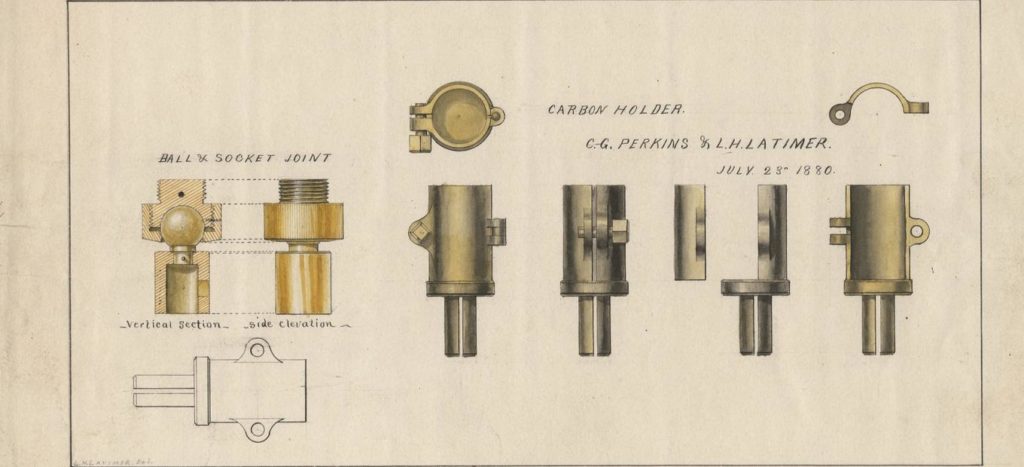
In 1882 Latimer began working for the Olmstead Electric Lighting Company of Brooklyn as superintendent of lamp construction and created the Latimer Lamp. Later he worked for the Acme Electric Company in New York and in 1883, Latimer became an engineer at the Edison Electric Light Company in Brooklyn. He had the distinction of being the only African American member of “Edison’s Pioneers” – Thomas Edison’s team of inventors. The Edison Electric Illuminating Company of Brooklyn provided electricity to the homes and businesses of Brooklyn and fabricated conductors for other plants like those in Milan, London, and Paris. Latimer continued to display his creative talents over the next several years. In 1894 he created a safety elevator, a vast improvement on existing elevators. He next received a patent for Locking Racks for Hats, Coats, and Umbrellas. The device was used in restaurants, hotels and office buildings, holding items securely and allowing owners of items to keep them from getting misplaced or accidentally taken by others, and the 1905 Book Supporter,
In 1919 the Edison Electric Light Company merged with Kings County Electric Light and Power Company to form Brooklyn Edison (Brooklyn Edison merged with Consolidated Edison and other companies between 1936 and 1960 In the early 1930s, the Brooklyn Edison Company created a 10 room house called the Edison Wonder House in the lobby of its showroom at Pearl Street in Brooklyn, New York. The house demonstrated the possibilities of electricity in the home. The demonstration home was not intended to be copied, but to provide future homeowners with ideas. Some special features of the house included lighting that was a sight saver, unusual clocks, a built-in aquarium, and a magic door that opened through the operation of an electrical eye.)
Latimer also developed other inventions of his own, co-patenting an electric lamp with Joseph V. Nichols in 1881, and, most important, refining light-bulb technology in 1882. In 1884 he was invited to work for Maxim’s arch rival, Thomas Alva Edison, in New York.
An expert electrical engineer, Latimer’s work for Edison was critical for the following reasons: his thorough knowledge of electric lighting and power guided Edison through the process of filing patent forms properly at the U. S. Patent Office, protecting the company from infringements of his inventions; Latimer was also in charge of the company library, collecting information from around the world, translating data in French and German to protect the company from European challenges. He became Edison’s patent investigator and expert witness in cases against persons trying to benefit from Edison’s inventions without legal permission.
Latimer also wrote the book, Incandescent Electric Lighting: A Practical Description of the Edison System. Published in 1890, it was extremely popular as it explained how an incandescent lamp produces light in an easy-to-understand manner. On February 11, 1918, Latimer became one of the 28 charter members of the Edison Pioneers, the only African-American in this prestigious, highly selective group. After leaving Edison, Latimer worked for a patent consultant firm until 1922 when failing eyesight caused an end to his career. His health began to fail following the death of his beloved wife Mary Wilson Latimer in 1924. To cheer and encourage him to carry on, his children, two daughters, had a book of his poems printed in 1925 in honor of his 77th birthday.
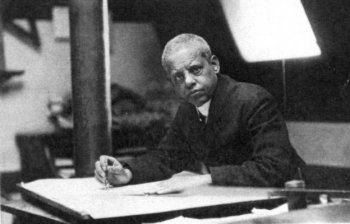
The poems are beautifully sensitive and complement Latimer’s designation as a “Renaissance Man” who painted, played the flute, wrote poetry and plays. Among the collection of poems was one written in tribute to his departed wife.
Ebon Venus
“Let others boast of maidens fair,
Of eyes of blue and golden hair;
My heart like needles ever true
Turns to the maid of ebon hue.
I love her form of matchless grace,
The dark brown beauty of her face,
Her lips that speak of love’s delight,
Her eyes that gleam as stars at night.
O’er marble Venus let them rage,
Who sets the fashions of the age;
Each to his taste, but as for me,
My Venus shall be ebony.”
Lewis Howard Latimer settled in Flushing, New York, and lived there until his death in 1928. Latimer’s house, where he lived from 1903 to 1928, still stands in Flushing, and is open to the public as the Lewis H. Latimer House. He was an active member of the local community, teaching English and drafting to immigrants at the Henry Street Settlement in 1906. In 1968, Latimer was posthumously honored by the borough of Brooklyn when a public school was named after him.
Latimer was also a member of the ‘Students Club of Brooklyn: a society comprised entirely of prominent black citizens dedicated to the best efforts, education, science, social and political economy, pedagogy, history, and questions affecting the colored American. In 1901, Latimer joined his colleagues at the headquarters of the SCB (then located at 184 Adelphi Street) to listen to an address presented by its president, inventor, Samuel R. Stratton (maternal grandfather of the singer Lena Horne) and engage in a general discussion regarding a proposition to offer formal education to black people along the lines of “manual training courses and in the trades, thus lifting them from the lowly level of much of their labor and bring them into a condition to better meet competition.”
Reference:
The African American Desk Reference
Schomburg Center for Research in Black Culture
Copyright 1999 The Stonesong Press Inc. and
The New York Public Library, John Wiley & Sons, Inc. Pub.
ISBN 0-471-23924-0
Watch a short documentary on Latimer
https://www.youtube.com/watch?v=oB3Mdw2lqkA
Black to School: The History of Colored School No.1
COLORED SCHOOL No. 1
By Carl Hancock Rux
“No great amount of research is required to find that one of the chief reasons for the intelligent and aggressive action of New York Negroes and for their position of leadership during the period between the Revolutionary and Civil wars lay in education.”
– James Weldon Johnson
In 1827, seventy odd years before Brooklyn would become annexed by New York City, the area now known as Fort Greene, Brooklyn, became the first district on the island to erect a school for the formal education of African Americans. Colored School No. 1 was founded in clapboard house in the area now know as Fort Greene Brooklyn: a free school for the instruction of African children. Located on Willoughby Street and Raymond in an area of Fort Greene heavily populated by African Americans, Colored School No. 1 numbered between 250 and 300 African American pupils, and was once cited by the Brooklyn Daily Eagle as “one of the best conducted institutions under the Education Department”. The building that housed the school for its first fifteen years, however, was described by its principal as “a dilapidated old wooden building. The accommodations almost too small from the start.” The school was later moved to a sturdy brick structure that cost $25,000, and is occupied by 450 scholars. They are divided into two departments, namely, primary and grammar— the first, as usual; being on the ground floor and the second on the floor above, with room for about one hundred more pupils. Colored School No. 3 (the building still existent) was erected in the Williamsburg section of Brooklyn in 1879, and was by then, the only remaining school exclusively used by African American students.
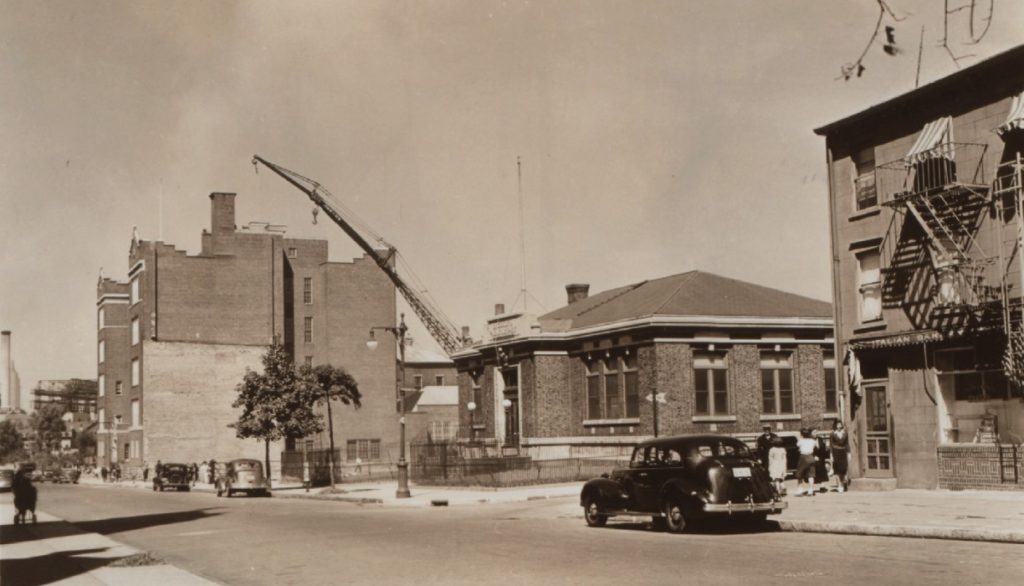
School No 1
African Americans constitute one of the longer-running ethnic presences in New York City. The majority of the African American population were forcibly abducted from their villages in West and Central Africa and brought to the American South via the Atlantic slave trade, with smaller portions of the population were voluntary immigrants from Caribbean, Latin American, and modern Sub-Saharan African nations. In New York City, the formal education of the African in America was institutionalized as the thirteen British colonies emerged as a new independent nation to be known as the United States of America, and, under the leadership of General George Washington, 13 states replaced the Articles of Confederation with the Constitution of the United States of America. With its amendments it remains the fundamental governing law of the United States today.
Following the establishment of the public school system in Brooklyn in 1850, the African Free School was incorporated into the system and renamed Colored School No. 1. In 1887 following the end of the segregated schools in Brooklyn, the Colored Schools were renamed, and Colored School No. 1 became Public School 67.
By the late 1800’s, colored schools (as they were then called) numbered about four in the city of Brooklyn—No. 1 on Willoughby and Raymond Street in Fort Green; No. 2 on Troy Avenue and Bergen Street In Crown heights; No. 3 on Union and South Third Street, in Williamsburg; and No. 4 on High street near Pearl street in what is today known as Downtown Brooklyn—with a registered number of approximately five to six hundred African American students, and a daily attendance of about four hundred across the four schools. The schools were presided over by African American principals and taught by African American teachers, and were considered proportionately as successful as the schools devoted to white children. Children of noticeable mixed ethnicities (African American and White) had the privilege of attending of white schools, but those of perceived “pure negro blood” were restricted to the colored schools.
In 1847, the tradition of tuition-free colleges and schools was captured best by its founder, Townsend Harris, who proclaimed at the founding of the Free Academy (the predecessor to the city’s first municipal college) that the city should: “Open the doors to all—Let the children of the rich and the poor take their seats together and know of no distinction save that of industry, good conduct and intellect.” This mission was realized primarily through a free tuition policy that was maintained at the city-supported municipal colleges for 129 years.
That same year, the Commissioner of the Board of Education demanded that $5,000 appropriated for the colored district, (approximately $158,000 in today’s currency) be placed in the hands of the treasurer for the betterment of Colored Schools. With funds in place, Colored School No. 1 was the largest colored school in Brooklyn with an attendance of about two hundred students (one hundred and twenty five students in the primary school and the remainder in the higher). Though called Colored Schools, all of the schools had a spattering of white students as well (three or four registered in each), and prided themselves in having “no distinction” between qualities of education in comparison to white schools.
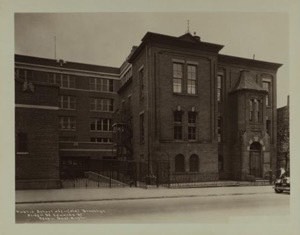
School No 1
Fort Green’s Colored School was not without precedent. One year earlier, a free school for the instruction of African children had lately been formed in Newark, New Jersey under the title of The Kosciusko School, named after the distinguished champion of civil liberty general Kosciusko who by his will, gave to Thomas Jefferson the available amount of $13,000 dollars to be employed in liberating enslaved Africans, and bestowing upon them such an education, “as, to use his own words, would make them better fathers, better mothers, better sons and better daughters.” Long before Brooklyn was officially annexed into the City of New York, The New York Society’s mission for the abolition of slavery predated the official union of the United States. By the 1760s, the American colonists began to wage a war of words and resistance against the British colonial government. The language of the dissenting colonists soon became the language of African Americans as well in their fight for personal freedom. Their poems, letters, and petitions used the rhetoric of the age to appeal for slavery’s abolition in the rhetoric of the age, noting King George had “waged cruel war on human nature itself, violating its most sacred rights of life and liberty in the persons of a distant people who never offended him, captivating and carrying them into slavery in another hemisphere, or to incur miserable death in their transportation thither.” Though not a war over slavery, a few white colonists publicly noted the paradox between the patriots’ demands for liberty and the widespread acceptance of slavery. Prominent Massachusetts’s lawyer James Otis called the slave trade “the most shocking violation of the law of nature” and posed a series of rhetorical questions which challenged the logic of enslaving blacks because of their physical characteristics. Before his death, Connecticut lawyer John Allen, in the Watchman’s Alarm questioned the values of his fellow colonists, chiding them for “enslaving [their] fellow creatures . . .. What is a trifling three-penny duty on tea compared to inestimable blessings of liberty to one captive?”
In a letter written Jan. 18, 1773, Patrick Henry of Virginia, President of the Virginia Abolition Society, wrote: ” Believe me, I shall honor the Quakers for their noble efforts to abolish slavery. It is a debt we owe to the purity of our religion to show that it is at variance with that law that warrants slavery. I exhort you to persevere in so worthy a resolution.” In the preamble to the act prohibiting the importation of slaves into Rhode Island (June, 1774) the following was written— “Whereas, the inhabitants of America are generally engaged in the preservation of their own rights and liberties, among which that of personal freedom must be considered the greatest, and as those who are desirous of enjoying all the advantages of liberty themselves, should be willing to extend personal liberty to others”. October 20, 1774, the continental congress passed a law to no longer “import nor purchase any slaves” after the “first day of December next, after which time we will wholly discontinue the slave trade, and we will neither be concerned in it ourselves, nor will we hire our vessels, nor sell our commodities or manufactures, to those who are concerned in it.”
In 1776, Dr. Stephen Hopkins, then at the head of New England divines, published a pamphlet entitled: “An Address to the owners of negro slaves in the American colonies,” in which he wrote: “The conviction of the unjustifiable practice of (slavery) has been increasing and greatly spreading of late, and many who have had slaves, have found themselves so unable to justify their own conduct in holding them in bondage, as to be induced to set them at liberty. May this conviction soon reach every owner of slaves in North America! Slavery is, in every instance, wrong, unrighteous, and oppressive, a very great and crying sin—they’re being nothing of the kind equal to it on the face of the earth.”
The colonies declared their independence from the Crown as “free and independent States” and the continental congress ordered a pamphlet to be published, entitled, ” Observations on the American Revolution,” from which the following is an extract: ” The great principle (of government) is and ever will remain in force, that men are by nature free; as accountable to him that made them, they must be so: and so long as we have any idea of divine justice, we must associate that of human freedom. Whether men can part with their liberty, is among the questions which have exercised the ablest writers; but it is conceded on all hands, that the right to be free can never be alienated—still less is it practicable for one generation to mortgage the privileges of another.” The Pennsylvania Act for the Abolition of Slavery, passed March 1, 1780, declared.” We conceive that it is our duty, and we rejoice that it is in our power, to extend a portion of that freedom to others which has been extended to us. Weaned by a long course of experience from those narrow prejudices and partialities we had imbibed, we find our hearts enlarged with kindness and benevolence towards men of all conditions and nations. Therefore be it enacted, that no child born hereafter be a slave,”
Thomas Jefferson (a slave owner) wrote ” The spirit of the master is abating, that of the slave is rising from the dust, his condition mollifying, the way I hope preparing under the auspices of heaven, for a total emancipation, and that this is disposed, in the order of events, to be with the consent of the masters, rather than by their extirpation.”
Formed in 1785, the New York Manumission Society chose John Jay as its first president, a position he held for five years. (Alexander Hamilton, its second president, held the office one year, resigning upon his removal to Philadelphia as secretary of the United States treasury.) In 1786, John Jay, afterward chief justice of the United States, drafted and signed a petition to the legislature of New York, on the subject of slavery, beginning with these words: ” Your memorialists being deeply affected by the situation of those, who, although by the laws of Cod, are held in slavery by the laws of the state,” This memorial bore also the signatures of the celebrated Alexander Hamilton; Robert R. Livingston, afterward secretary of foreign affairs of the United States, and chancellor of the state of New York ; James Duane, mayor of the city of New York, and many others of the most eminent individuals in the state. In 1787, the Pennsylvania Abolition Society was formed. Benjamin Franklin, warm from the discussions of the convention that formed the United States constitution, was chosen president, and Benjamin Rush, secretary—both signers of the Declaration of Independence and the Manumission Society founded the New York African Free School. Members provided or raised funds for teachers’ salaries, supplies, and, eventually, for the creation of new buildings to accommodate a growing student population. In addition, members were responsible for checking in on the school periodically and reporting on the state of the school and the students. In 1789,the Maryland Abolition Society was formed. In 1790, the Connecticut Abolition Society was formed. In 1791, this society sent a memorial to congress, from which the following is an extract:” From a sober conviction of the unrighteousness of slavery, your petitioners have long beheld, with grief, our fellow-men doomed to perpetual bondage, in a country which boasts of her freedom. Your petitioners are fully of opinion, that calm reflection will at last convince the world, that the whole system of African slavery is unjust in its nature—impolitic in its principles—and, in its consequences, ruinous to the industry and enterprise of the citizens of these states. From a conviction of these truths, your petitioners were led, by motives, we conceive, of general philanthropy, to associate ourselves for the protection and assistance of this unfortunate part of our fellow-men; and, though this society has been lately established, it has now become generally extensive throughout this state, and, we fully believe, embraces on this subject, the sentiments of a large majority of its citizens.” The same year the Virginia Abolition Society was formed. This society, and the Maryland society, had auxiliaries in different parts of those states. Both societies sent up memorials to congress. The memorial of the Virginia society is headed—” The memorial of the Virginia Society, for promoting the Abolition of Slavery, &c.” The following is an extract: ” Your memorialists, fully believing that ‘ righteousness exalteth a nation,’ and that slavery is not only an odious degradation, but an outrageous violation of one of the most essential rights of human nature, and utterly repugnant to the precepts of the gospel, which breathes ‘ peace on earth, good will to men;’ lament that a practice, so inconsistent with true policy and the inalienable rights of men, should subsist in so enlightened an age, and among a people professing that all mankind are, by nature, equally entitled to freedom.” About the same time a society was formed in New Jersey. It had an acting committee of five members in each county in the state. The following is an extract from the preamble to its constitution. ” It is our boast, that we live under a government founded on principles of justice and reason, wherein life, liberty, and the pursuit of happiness, are recognized as the universal rights of men; and whilst we are anxious to preserve these rights to ourselves, and transmit them inviolate, to our posterity, we abhor that inconsistent, illiberal, and interested policy, which withholds those rights from an unfortunate and degraded class of our fellow-creatures.”
Later, the Manumission Society lobbied to pass the 1799 law which granted gradual manumission to New York’s slaves and provided legal assistance to both free and enslaved blacks who were being abused, but not all members were abolitionists (many were slaveholders and rejected Alexander Hamilton’s suggested resolution that anyone who wanted to be a member had to free their slaves) and often disapproved of how black New Yorkers chose to celebrate these victories, including a lavish parade to celebrate the abolition of the slave trade in 1808, causing the Manumission Society to express concern that “celebrating” Abolition was “improper” and might “cause [detrimental] reflections to be made on this Society”, demanding such parades be discontinued. Black New Yorkers replied that they would do no such thing. Even so, in line with the revolutionary beliefs of many of its founders, the New York Manumission Society the Society fought on behalf of the freedom, and eventual rights, of black New Yorkers, and felt that education was vital to creating citizens that would be capable of sustaining a democracy.
African Free School No. 2, (or, the “Mulberry Street School” as it was called by its pupils) once occupied 135-137 on a plot of land surrounded by trees. Founded by the Manumission Society on Jan. 25th, 1785, The Manumission Society was an organization of esteemed men who concerned themselves not only with the emancipation of negroes, but the with the formal education of African Americans as a means of provoking public awareness to the “growing evil” of “kidnapping colored people and selling them at the south” (In the city of Philadelphia a society had already been formed to protect blacks from similar dangers there and a deputation was sent from New York to that society for information, and to procure a copy of its constitution, which assisted much in the organization of the New York Manumission Society”) and to divert black children from “the slippery paths of vice” and as a way of teaching African American children “industry” and “sobriety”, the AFS became an act of “egalitarian faith”, reflecting the Quaker roots of many of its members. At the society’s fifth meeting in August of 1785, the society took on the charge of monitoring the moral character and work ethic of free blacks. Several months later, a school for African Americans was proposed with the reasoning that education would thwart behavior reflecting badly on African Americans and masters of slaves might be convinced to manumit their slaves if they thought they could handle their freedom responsibly. The NYMS also hoped that by exposing black children to positive white role models, their pupils could undermine white “prejudice” and Black “vice.” After establishing a committee to solicit subscriptions for the school’s benefits, the society announced its plans to the general public and drew up a plan to enroll black boys and girls between the ages of five and fourteen years of age. Approval for admission depended upon a visit to the family by the school’s governing committee with a preference given those “families which are most regular and orderly in their Deportment” and children with a “posture of quiet obedience” while “in school and in the street”. In August 1788, the NYMS reported forty enrolled children “regular in their attendance” and were happy to report that they had succeeded their expectations.
Most of the AFS board members were Revolutionary leaders who came to power in New York, propagated anti-slavery sentiments, and were members of the Manumission Society. One year after the Manumission Society founded the AFS, the slave trade in New York State was “banned outright” but with loopholes, leaving the slavery issue a matter of reality for many of its African Americans at least until 1841 when slavery became the focus of sectional rivalry and the North re-defined itself as a “free” region.) Over the years five schools popped up in various locations of Manhattan, all below 19th street.
The schools were designed to educate the newly freed African American children of New York, and specifically targeted ‘respectable’ children for education. Both boys and girls attended but studied different curricula. The schools ran from eight in the morning until five in the afternoon, with a two-hour lunch break. Students learned reading, writing, mathematics, penmanship, astronomy, geography and composition. Older students taught the younger ones in a system of peer education. Stress was put on teaching correct morals to the young ones. Unlike white charity schools, exclusively reserved for the poor, the first school for “colored children” in New York, both free and enslaved, became a focal point of aspirations for a better future for New York’s African Americans. In 1788 the first African Free School enrolled fifty-six students and by 1792 a school for girls was incorporated. It was not until 1796 that a school building was purchased explicitly for the purpose of educating New York’s African American community as part of the mission of the New York Manumission Society. The original single room schoolhouse (in what is now the Financial district) opened with about forty students, many of whom were the children of slaves, under the schoolmaster Cornelius Davis and a female teacher employed to teach female students needlework. After the schoolhouse burned down in 1814, members of the New York Manumission Society raised funds for a new building on William Street. As the city of New York expanded, its population ever increasing, the demand for more schools grew. Eventually, there would be six AFS sites throughout Manhattan: AFS No. 1 (245 Williams St. near Duane); AFS No. 2 (135-137 Mulberry St.); AFS No. 3, first opened in 1831 on Nineteenth Street near Sixth Avenue, under the direction of Benjamin F. Hughes and after objections from whites in the area, relocated to Amity Street or what is now Great Jones Place near Sixth Avenue); In 1835, the African Free School was integrated into the public school system.
AFS No. 2 was one of seven schools in New York the first school to formally educate New York’s African American children, both free and enslaved, so that they might hereafter become “useful members of the community, “.
The great and noble cause of educating African Americans was far from being a popular idea. The prejudices of a large portion of the community were against it; the means in the bands of the trustees were often very inadequate, and many seasons of discouragement wore witnessed; but they were met by men, trusting in the divine. Little was done during the Revolutionary war towards ending slavery until 1781 when the legislature voted to manumit slaves serving in the armed forces. Many slaves ran off to the British during the occupation of the state. Others achieved freedom by taking up the rebels’ offer of manumission in exchange for military service. The slave population of New York City was permanently reduced. When the British and the American Loyalists pulled out of New York at the end of the war, some 3,000 blacks left with them. In 1785, when the fighting was over, New York legislature got around to the antislavery question. Though there was a clear antislavery majority in both houses, there existed a split between moderates as to how to implement emancipation. Though anti-slavery representatives, such as the Manumissions and the Democratic-Republican Party, advocated for the immediate and unconditional abolition of slavery, by now a split had developed between moderates, who favored a gradual emancipation. Anti-slavery sentiments seemed to have predominated the Assembly, and the question of civil rights for African Americans as well as the larger issue of full citizenship, suffrage and interracial marriage—all causing considerable disagreement and public political debate. Rejecting the proposal for complete abolition a bill was offered introducing gradual emancipation of slavery, providing children born of enslaved women after 1785 “be free from birth”, along with other riders including denying African Americans the right to vote or hold public office, and barring intermarriage to white persons or giving testimony against whites in any court of the state. With this bill, the second class citizenship of African Americans in New York State was almost ensured, but the Senate’s strong stance that such restrictions were not only unsound public policy but would perpetuate distrust among the races and increase civil disorder, sent the bill back to the Assembly for reconsideration. A revised bill gave in on all counts except “negro suffrage”; thus, the bill was passed with clear notice that there would be no emancipation law that did not include voting restriction. A law was also passed that year (1785) prohibiting the importation of slaves for sale with penalty of 100 pounds for the importer and freedom for the slave (persons importing slaves for personal use were not under penalty of law, but the Act of 1785 was strengthened by the provision that the sale of any imported slave would operate his freedom).
The bill also seemed to encourage the states African Americans that anti-slavery activists, including the Manumission Society, would continue to fight for emancipation on their behalf and that the “slavery issue” would soon be resolved by law as it had been in other northern states (there were almost no advertisements for runaway slaves in New York State in 1785).
Having helped prohibition of the slave trade, individual states were free to take the initiative whenever they pleased. New Jersey and Rhode Island led the way in 1787, with Massachusetts, Connecticut and New York soon following, easing restrictions on Africans already committed to slavery; and by 1788, New York legislature passed a law prohibiting the exportation of the slave trade altogether, providing freedom for any slave exported. Still, the matter of secular education of African American children in New York state was a matter persevered for implementation by the Manumission Society, or what was known as “The New York Society for the Manumission of Slaves and the Protection of such of them as had been or wanted to be Liberated”.
In Brooklyn (in the old Town of Williamsburg) Colored School #3 continued to pursue an overall policy of segregated education, even after the State of New York passed a law ostensibly desegregating the state’s schools in 1873. By 1879 the school had become overcrowded, and parents petitioned the school board for a new building. Samuel Leonard (1821-1879), who was in charge of school construction in Brooklyn from 1859 to 1879, drew up plans in the Romanesque Revival style that was popular for school buildings at that time. The building, with four classrooms for 220 students, was completed in 1881 at 270 Union Avenue, at a cost of $8,963. Soon after the school’s construction, the practice of school segregation in Brooklyn began to change.
By the 1870s, most of the black public schools had closed. By the 1880s and 1890s, African Americans, their education, and their integration into American society post-emancipation, was no longer in favor. While former Confederate States in the American South had begun to introduce Jim Crow laws, thus becoming increasingly segregated, the North had grown increasingly tired of reconciling the civil liberties of African Americans. All across America, white prejudice increased. Even among militant African Americans in the North, the need for segregated Colored Schools had become outmoded, and therefore, challenged. In fact, many Northern African American leaders, championed, the desegregation of schools by the 1880s, and aspired to abolish black public schools altogether before the close of the 19th century. 1882, Seth Low, the new mayor of Brooklyn and a reformer, appointed Phillip A. White as the first African-American member of Brooklyn’s Board of Education. White, who became the chairman of a committee in charge of the city’s colored schools, opposed forced segregation and disliked the term. 19th century civil rights activist, Timothy Thomas Fortune (an American orator, civil rights leader, journalist, writer, highly influential editor of the nation’s leading black newspaper, The New York Age) argued that the abolition of black schools in the north also threatened the jobs of black teachers. By wiping out one injustice, he argued the Board of Education was creating another injustice “as repugnant as the first.” The Brooklyn Board of Education, however, rejected Fortune’s argument, and in early 1883, directed a committee to prepare for the complete abolition of black schools without continuing to employ the twenty six remaining black teachers. In the struggle to keep black the few remaining black schools open, and their teachers employed, many black educators canvassed New York City, offering free elevated-railroad tickets to potential students, both black and white, as an inducement for them to attend their schools, most of which were a great distance from their homes. The plan was unsuccessful. Many black parents, when possible sent their children to white schools and few, if any, white parents were willing to send their children to colored schools. Black real estate broker, Simon King, sued New York City Schools in a Brooklyn court when his daughter was refused entry to any of the public schools because of her race. On an appeal in 1883, the state’s highest court decided against King. However, prominent druggist, Phillip A. White, appointed by the Mayor as a member of the Brooklyn Board of Education (Brooklyn was the only place in the state known to have blacks on its board in the 19th century) introduced a resolution directing all the city’s white public schools to except black children. By 1890, most African-American students chose to enroll in the integrated schools, and the enrollments of the colored schools had begun to decline.
White’s plan also insisted that Brooklyn schools continue to hire black teachers as well, urging more blacks to take the exams necessary to attain Brooklyn teaching certificates. As a result, the number of Black teachers increased, even during the desegregation of Brooklyn’s schools. Black teachers outside the city of Brooklyn, however, had no blacks on their school boards championing their cause, and as a result, many African American children continued to face illegal discrimination from public schools and thus went uneducated while black educators either attempted to open schools for children in their homes or were made redundant altogether ( by 1895, no Black teachers were known to have been appointed to teach in traditionally white public schools of either Brooklyn or New York City).
As Brooklyn faced one of many early waves of early gentrification, many Black neighborhoods were becoming increasingly white and parents of children insisted upon the education of their children in a new of wave of newly erected schools, as some blacks also did. However, in a joint meeting of black and white educators, it was decided that the only way to proceed with the matter of public education was to proceed with the matter of integration of public schools, students and teachers alike. African-American students were given the option to attend integrated schools, and Colored School #3 was renamed P.S. 69, making its name consistent with those of integrated schools (though white parents, for the most part, kept their children from attending the school, and as a result, it it continued to serve an exclusively African-American student body. The other two colored schools were similarly renamed.
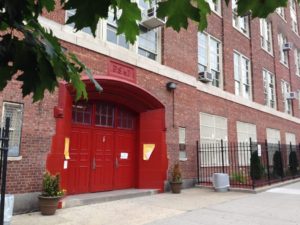
School No 1
Scant evidence of the numerous colored schools in New York City or the ton of Brooklyn remains. However, the following might shed some light on the intellectual prowess of 19tth century students of the African Free School.
On a Thursday, Sept. 21st, 1826, Dr. Samuel L. Mitchell visited the African Free School No. 2. in Manhattan. Graduate of the University of Edinburgh Medical School, Practicing Physician, Professor of Chemistry and Natural History at Columbia College, co-founder and chief editor of the New York Medical Repository (the first scientific periodical published in the United States), founder of the foundation of New York City’s first Zoological Museum as well as one of the earliest collections in natural history at the University of New York, organizer and first president of the Lyceum of Natural History, published author, member of the New York State Legislature, Congressman and United States Senator—Dr. Mitchell interviewed one of the students, ten year old George R. Allen, and put the following questions (recorded verbatim by a third party and later published in The African Repository and Colonial Journal):
- Q. What keeps the several parts of this together?
- A. The attraction of cohesion.
- Q. What is the attraction of cohesion?
- A. It is the power, which binds the several parts of bodies together, when they are placed sufficiently near each other, or prevents them from separating, when they touch.
- Q. Has the earth any attraction?
- A. Yes sir, the attraction of gravitation.
- Q. What is the earth?
- A. It is a planet, and the third in the solar system.
- Q. What surrounds the earth?
- A. The atmosphere.
- Q. Of what does the earth consist?
- A. Of land and water.
- What shape is the earth?
- A. The earth is round.
- Q. How do you know it is round?
A.Because we can see the tops of ships mast first at sea.
A.Does the earth stand still or move?
A.It moves on its axis, and has the motion round the sun.
- Q. What takes place from these motions?
A.Its motion round the sun produces the changes of the seasons; and its motion on its axis, the succession of day and night.
- Q. If the earth turns round, why are we not turned heels up at midnight?
- A. Because the attraction of gravity draws all bodies towards the centre of the earth.
Q.Does any other planet obey the laws of gravitation?
- A. Yes sir, Mars, as well as other smaller planets called asteroids, Jupiter, etc.
- Q. Has the earth any satellite?
- A. Yes, the moon is the earth’s satellite.
Q.Has any other planet a satellite or moon?
- A. Yes, Saturn has seven and Jupiter has four, and they all gravitate towards their respective principals.
Q.Have we any antipodes?
- Yes, Sir, they are the people directly under us, they have their feet opposite to our feet.
Q.What is the nearest shape in nature to the earth?
A.An orange, because it is flattened at each end, like the poles of the world.
Q.Does not the power of gravity act upon all bodies?
- A. Yes sir.
- Q. Why then does not the earth’s attraction bring down the moon upon us?
- A. Because the greatest distance that the moon is from the earth lessens the effect of the power of gravity upon it; for, the effects of a power which proceeds from a centre, decreases as the squares of the distance from that centre increases; and as the moon is at the distance of sixty semi-diameters of the earth from the earth; the square of 60 is 36,000 and as the earth’s attraction upon the moon is 36,000 times less at the moon than at the earth’s surface, it keeps at its present distance from us.
- Q. Do you know what weight it is?
- A. Yes sir, it is the attraction of gravitation.
- Q. How much would a ball, which here weighs a pound, weigh if it were removed 4,000 miles from the earth?
- A. As it then would be double the distance from the centre of gravity, the square of 2 is 4, and according to the rule I mentioned just now, the ball would weigh but a quarter of a pound, or one fourth of what it weighs here.
At the conclusion of the interview, a document was drawn, dated “September, 1826” stating “The little black boy, G.R. Allen, is entitled to the credit of answering the preceding questions, in the manner stated, without previously knowing exactly what was to be propounded to him” , signed “Samuel L. Mitchell”.